NFL Spread Betting Strategy: Key Numbers and ATS Edges
 Available in US
Table of Contents
- NFL Spread Betting Mechanics: Analyzing UK Bookmaker Margins
- Reading NFL Spreads in Decimal Odds: A UK Translation
- Why 3 and 7 Dominate NFL Spread Results
- Alternate Spreads: Buying and Selling Points Profitably
- ATS Trends That Actually Hold Up Over Multiple Seasons
- When Favourites Cover and When Underdogs Cash
- Early-Week vs. Kick-Off Lines: When to Place Your Spread Bet
- Spread Betting at UK Bookmakers: Handicap Markets Compared
- NFL Spread Betting Questions Answered
NFL Spread Betting Mechanics: Analyzing UK Bookmaker Margins
I lost my first ever NFL spread bet on a Thursday night in October 2017. The Pittsburgh Steelers won by six points and I sat there thinking I’d backed a winner — until I realised my -7 ticket meant they needed to win by seven or more. That gap between winning the game and covering the number is exactly where spread betting lives, and nine years later it remains the single most important concept I teach UK bettors who want to move beyond straight moneyline wagers.
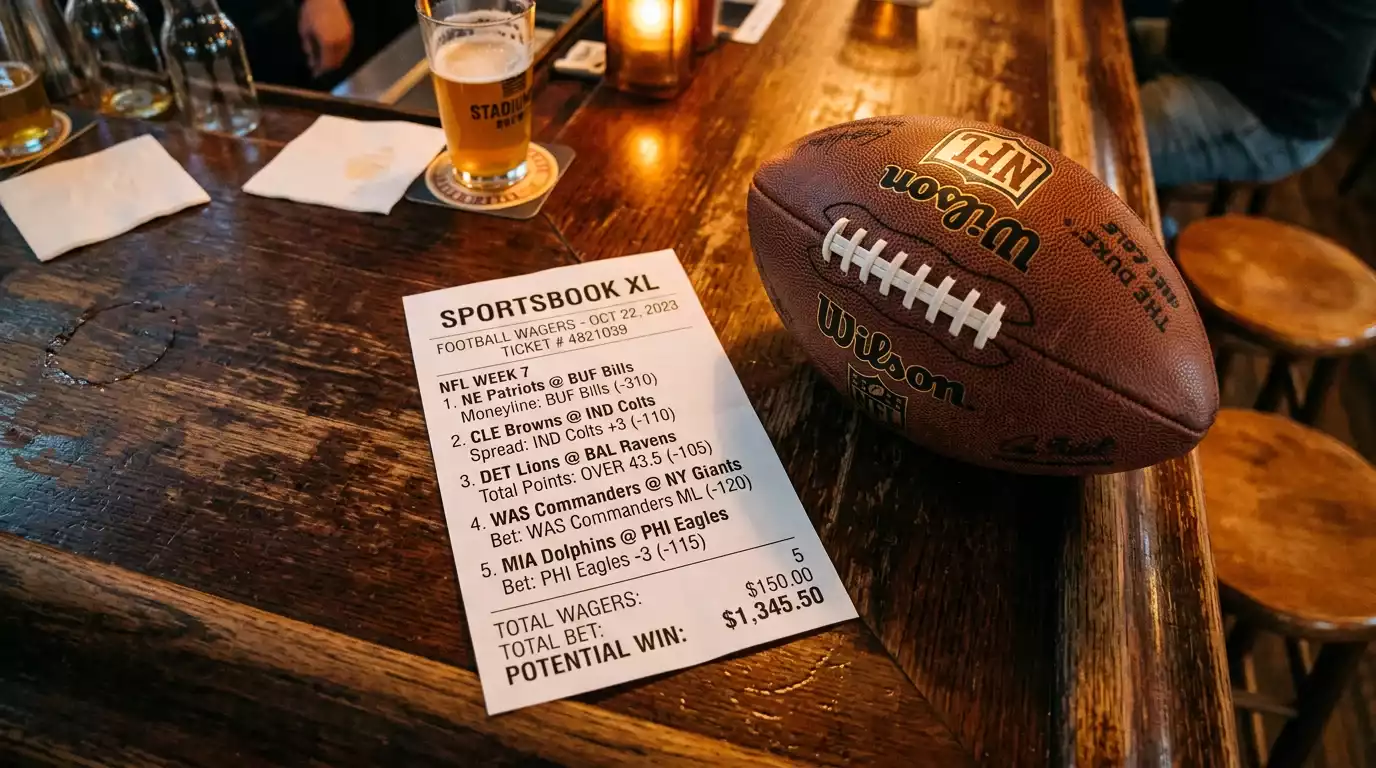
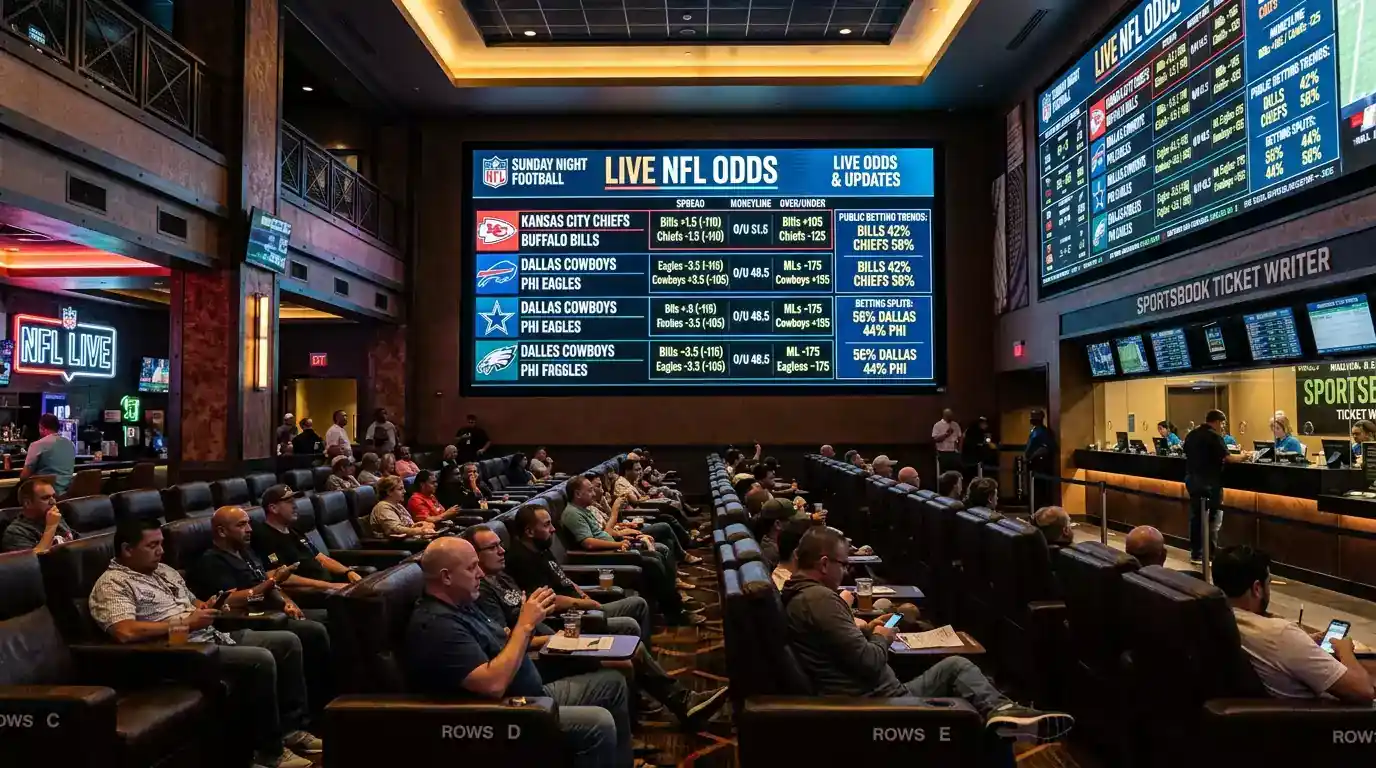
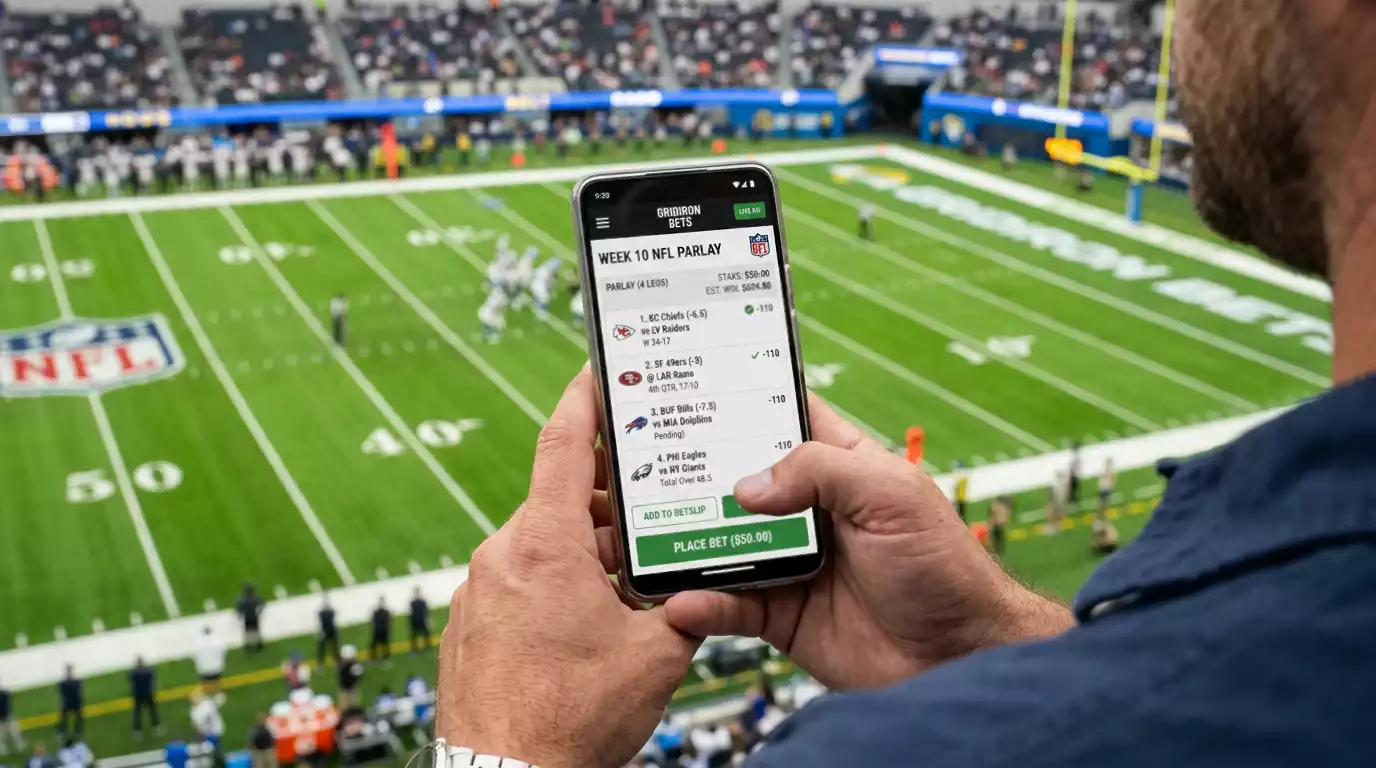
A point spread is the bookmaker’s way of levelling an uneven contest. If the Kansas City Chiefs are listed at -6.5 against the Las Vegas Raiders, the Chiefs need to win by seven or more points for a spread bet on them to pay out. The Raiders, at +6.5, can lose by six and your ticket still cashes. The number is designed to attract roughly equal action on both sides, which is why it shifts throughout the week as money comes in.
In the 2025 season, favourites won 65.9% of NFL games outright but covered the spread only 47.8% of the time — a sharp drop from the 2024 season when favourites covered at 53.3%. That gap between winning and covering is the entire reason spread betting exists as a strategic discipline rather than a coin flip. The bookmaker’s margin sits inside the odds attached to each side (typically 1.91 in decimal, the equivalent of American -110), meaning you need to win roughly 52.4% of your spread bets just to break even after the vig is deducted.
Understanding that baseline changes how you think about every spread ticket you place. You are not trying to predict winners. You are trying to identify spots where the number is wrong by a point or two — where public perception, injury news or a quirk of scoring distribution gives you a price that doesn’t reflect the true probability. The rest of this guide is about building the toolkit to find those spots consistently.
Reading NFL Spreads in Decimal Odds: A UK Translation
When I first started sharing NFL picks with mates who bet on football — the round-ball kind — the biggest friction wasn’t the sport itself. It was the odds format. American sportsbooks quote spreads at -110 on each side, which means nothing to someone used to seeing 1.91 or 10/11 on their Bet365 slip. So let me bridge that gap properly, because if you can’t read your price at a glance you can’t react when the line moves.
A standard NFL spread at a UK bookmaker looks like this: Kansas City Chiefs -3.5 at 1.91, Las Vegas Raiders +3.5 at 1.91. That 1.91 is the decimal odds equivalent of -110 American. To calculate your return on a 10-pound stake, multiply: 10 x 1.91 = 19.10 total return, which is 9.10 profit. The implied probability embedded in 1.91 odds is 52.4% (1 / 1.91), which is higher than 50% — that difference is the bookmaker’s margin, or “overround.”
Some UK books list NFL handicap markets in fractional odds. A -3.5 spread at 10/11 is mathematically identical to 1.91 decimal. My advice: switch your account display to decimal odds and leave it there. Fractions get awkward fast when you’re comparing a -3 at 5/6 versus a -3.5 at 10/11, and mental arithmetic under time pressure during a live line shift is a recipe for expensive mistakes.
One quirk worth noting: UK bookmakers sometimes present NFL spreads under “handicap” markets rather than “point spread.” The mechanics are identical — a -3.5 handicap and a -3.5 spread pay out the same way — but the label can confuse bettors coming from American resources. Some books also offer three-way handicap markets (with a draw option when the handicap is a whole number), which changes the odds structure entirely. The difference between a two-way spread and a three-way handicap matters for how you calculate implied probability, and it’s worth understanding both formats if you’re comparing prices across multiple UK platforms.
The critical habit is this: before placing any spread bet, convert the decimal odds to implied probability. If the book offers Chiefs -3 at 1.95, the implied probability is 51.3%. If your own analysis says the Chiefs cover at 55%, you have a positive expected value bet. If the book offers 1.87, the implied probability is 53.5% — and at 55% your edge shrinks to a sliver. A tenth of a point in odds matters more than most people realise, which is why the line shopping section later in this piece exists.
Why 3 and 7 Dominate NFL Spread Results
A field goal is worth three points. A touchdown with an extra point is worth seven. That sounds like nursery-level knowledge, but the downstream effect on spread betting is enormous — and most casual bettors never internalise it properly.
NFL games cluster around specific final margins. Across thousands of games, a margin of exactly three points occurs roughly 15% of the time. Seven-point margins account for another 9-10%. Together, those two numbers represent nearly a quarter of all NFL outcomes. No other margins come close. Six points (a touchdown without the extra point, or two field goals) and ten points (a touchdown-plus-field-goal lead) are the next most common, but they each appear in only about 5-6% of results.
Billy Walters — widely considered the most successful sports bettor of the past fifty years — built part of his edge on this exact principle. He understood that the difference between laying -2.5 and laying -3 on a favourite is not half a point of margin. It is the difference between winning and pushing (or losing) on roughly 15% of outcomes. That half-point is worth real money over a season of bets, and oddsmakers know it. That’s why you’ll often see different juice on either side of 3 — a spread of -3 might be offered at 1.83 on the favourite side rather than the standard 1.91.
The practical takeaway is simple but powerful. When you’re considering a spread bet and the line sits at -3 or +3, every half-point of movement through that number changes the probability of your bet cashing by a larger increment than it would at, say, -5 or +5. The same logic applies at 7 and, to a lesser extent, at 10 and 14. In the full breakdown of key numbers and margin distribution, I walk through the exact percentages for each number — but the core rule is: never give away a half-point through a key number without getting properly compensated in the odds.
Here’s how I apply this in practice. If I see a line at -2.5 and I fancy the favourite, I place the bet immediately. If it moves to -3 before I act, I usually wait — because I know a percentage of games will land exactly on three, and that push (or loss, depending on whether I got -3 or -3.5) erodes my edge. Conversely, if I like an underdog and the number is +2.5, I might wait to see whether the line drifts toward +3, giving me the hook on the key number. That patience has paid for itself dozens of times across nine seasons.
Alternate Spreads: Buying and Selling Points Profitably
Most UK bookmakers now offer alternate spreads — sometimes labelled “alternative handicap” — where you can buy or sell points on the standard line. I ignored these markets for my first three years of NFL betting, assuming they were sucker bets with inflated margins. I was wrong. Used selectively, they’re one of the sharper tools in a spread bettor’s kit.
Buying points means taking a less favourable number at worse odds. If the standard line is Chiefs -6.5 at 1.91, buying a point gives you Chiefs -5.5 at around 1.74. Your payout drops, but you’ve moved past a secondary key number (6) and reduced the probability of a loss on a one-score game. Selling points works the other way: Chiefs -7.5 at 2.10 means you need a bigger margin of victory, but you get paid more when it hits.
The decision of when to buy or sell hinges entirely on key numbers. Buying from -3.5 down to -2.5 moves you off the most dangerous number on the board and is almost always worth the juice. Buying from -7.5 to -6.5 accomplishes the same through the second key number. But buying from -5.5 to -4.5? That move crosses no key number and you’re paying extra juice for a half-point that changes the outcome in a much smaller percentage of games. The marginal value doesn’t justify the cost.
Selling points is the mirror image. Moving from -2.5 to -3.5 crosses through 3 in the wrong direction — you’re now losing on all those games that land exactly on three. The extra payout rarely compensates. But selling from -4.5 to -5.5 crosses nothing critical, and the better odds can be worth the trade-off if your analysis says the favourite wins comfortably.
I keep a simple mental rule: buy through key numbers, sell away from them. It’s not sophisticated, but it’s saved me money consistently. One more thing — alternate spread odds vary significantly between UK bookmakers. I’ve seen the same -2.5 alternate line priced at 1.70 on one platform and 1.78 on another, which is a meaningful difference over a season’s worth of bets. If you’re going to use alternate lines, you need accounts at multiple books, period.
ATS Trends That Actually Hold Up Over Multiple Seasons
Every September, someone on Twitter — sorry, X — posts a thread claiming that road underdogs after a bye week on grass surfaces in the Eastern time zone are 14-3 ATS over the last five seasons. That’s not a trend. That’s a sample so small and so over-fitted that it tells you nothing about the future. I’ve learned the hard way that separating real ATS patterns from noise requires two things: a large enough sample and a logical reason for why the pattern should persist.
The pattern that has held up most reliably over the past decade is this: short underdogs — teams getting between 1 and 3.5 points — cover the spread at a rate above the 50% baseline. The reason is structural. Oddsmakers shade lines toward public favourites because casual money pours in on popular teams. The result is that the number on close matchups tends to be a half-point or a full point wider than the true probability warrants. That extra point might not sound like much, but over a season of 50 bets on short dogs, it’s the difference between breaking even and turning a profit.
In 2025, the Seattle Seahawks led the league in ATS record at 12-5, while the Kansas City Chiefs — the most publicly backed team in the sport — failed to cover in ten of their seventeen regular-season games. That’s not a coincidence. Public perception inflates the lines on marquee teams. The Seahawks, who operated under the radar for much of the season, consistently faced deflated numbers that underestimated their defensive improvement.
Another durable trend is the unders lean in divisional rematches. When two teams from the same division meet for the second time in a season, defences have a schematic advantage from the film study. Coordinators adjust to what hurt them in the first meeting, and scoring often drops. I track this specifically because the totals market tends to anchor on season-long averages rather than adjusting for the familiarity factor.
What I avoid entirely: chasing ATS records from the current season alone. A team that starts 7-1 ATS through eight weeks is not “due” to regress or “on fire.” Eight games is a sample so small that randomness explains the record better than skill. I need at least two full seasons of data before I’ll treat a team-level ATS pattern as meaningful — and even then, I look for the why behind the what. If there’s no causal story, it’s noise, and I move on.
When Favourites Cover and When Underdogs Cash
People constantly ask me: “Should I bet favourites or underdogs?” — as if one side is inherently more profitable. It’s the wrong question. The right question is: at what price, and in what situation?
The 2025 regular season gave us a vivid illustration. Favourites won nearly two-thirds of games outright, so if you’d taken every favourite on the moneyline you’d have cashed a lot of tickets. But favourites covered the spread in fewer than 48% of games, meaning laying the points was a losing proposition on a blanket basis. The explanation is straightforward: oddsmakers set the line knowing where the public money will land, and the public gravitates toward favourites. That gravitational pull inflates the spread beyond the true margin, handing systematic value to the other side.
That doesn’t mean underdogs are free money. Big underdogs — teams getting 10 or more points — cover at a decent clip, but the variance is brutal. You’ll endure long losing runs because you’re backing teams that lose outright most of the time, and the psychological toll of watching your side trail by three scores is real. I limit my exposure to big dogs and concentrate my underdog action on the +1 to +6 range, where the teams are competitive enough to win outright on a good day and where the line is most likely to be shaded by public money on the other side.
Favourites, meanwhile, cover best in specific situations. A strong favourite at home coming off a loss (the “angry favourite” angle) has outperformed over long samples, likely because motivation and preparation peak after a defeat. Favourites also cover more frequently in games with a low total, because low-scoring environments reduce the variance in margin of victory — a 13-10 game is more likely to land near the spread than a 38-31 shootout where garbage-time touchdowns swing the number in the final minutes.
The framework I use is simple. I don’t start with a side. I start with the number. I look at the spread, assess whether the market has priced the favourite too aggressively or the underdog too generously, and only then decide which side offers value. Some weeks I back three favourites and zero underdogs. Other weeks the reverse. Dogmatic loyalty to one side is the fastest way to hand your edge to the bookmaker.
Early-Week vs. Kick-Off Lines: When to Place Your Spread Bet
Sunday evening in the UK — that’s when most NFL lines for the following week first appear. I’ve got a standing alarm for it. Not because I always bet that early, but because seeing the opening number is the reference point against which everything else is measured. The gap between where a line opens and where it closes at kick-off tells you who moved it, and understanding that flow is the difference between getting a good number and chasing a stale one.
Early-week lines are set with incomplete information. Injury reports don’t solidify until Wednesday’s practice designations, and even those are unreliable until the Friday update. Weather forecasts for outdoor games sharpen as the week progresses. Sharp bettors — the professionals who trade large volumes — tend to hit opening lines hard if they spot a mispricing, which moves the number quickly by Monday or Tuesday. By Thursday, the line has typically absorbed the sharpest opinions and settles into a range that holds until late-week injury news creates a final adjustment.
For most UK bettors, the practical window I recommend is Tuesday through Thursday. By then, the opening has been corrected for the most obvious mispricings (so you’re less likely to be on the wrong side of a sharp move), but late-week injury news hasn’t yet been fully priced in, which sometimes creates one final window of value. Waiting until kick-off — 6pm or 9:25pm on Sunday in UK time — means you’re betting into the most efficient line of the week, where the bookmaker’s number has had seven days of market input. That’s the hardest line to beat.
There’s an exception. If you have a strong opinion on a game early in the week and the line sits on a key number that you expect to move through, bet immediately. A -2.5 that you project will drift to -3 by Sunday is worth locking in now, even before injury reports. The breakeven threshold for standard spread bets is 52.38% — which means getting the right number on even a few extra games across a season can flip you from slight loser to slight winner. Timing is not a minor detail. For spread bettors, it’s a core skill.
Spread Betting at UK Bookmakers: Handicap Markets Compared
I maintain active accounts at five UK bookmakers specifically for NFL spread betting. Not because I enjoy juggling logins — it’s a hassle — but because the differences in how UK books price NFL handicap markets are large enough to affect my bottom line over a full season.
The traditional home-field advantage adjustment in NFL spreads has been shrinking for decades. Oddsmakers used to bake roughly three points into the spread for the home team; that figure has halved to about 1.5 points in recent years. Billy Walters has pointed out that the actual average home-field advantage across NFL games dating back to 1974 sits closer to 2.5 points — and over the last four years, it’s been less than one point. But not all UK bookmakers have updated their models at the same pace. I’ve seen home-field adjustments vary by a full point between two books on the same game, which means the spread itself differs — not just the odds attached to it. When one book has the Chiefs at -3 and another has them at -4 for the same fixture, you’re looking at a fundamentally different bet, and the one offering -3 is almost certainly the better value if you fancy Kansas City.
Market depth is another differentiator. The larger UK operators tend to offer full alternate handicap lines from -1.5 to -13.5 (and the mirror), quarter lines, and half-time handicaps. Smaller or newer platforms might list only the main line and a couple of alternates. If your strategy involves buying and selling through key numbers — as I’ve outlined above — you need the full menu.
One UK-specific advantage worth noting: your winnings from spread bets are tax-free. The bookmaker pays the point-of-consumption tax, not you. American bettors face federal and state taxes on gambling profits, which effectively reduces their returns. For a UK-based bettor operating at the thin margins of spread betting (where a 54% win rate is considered excellent), that tax-free status is a genuine structural edge. It means your 54% translates directly to profit without a further haircut, widening the gap between you and the breakeven point.
Finally, watch how each bookmaker handles NFL spread markets on game day. Some books are slow to update lines during the late injury window (90 minutes before kick-off), which creates brief arbitrage opportunities. Others suspend markets aggressively at the first whiff of breaking news, giving you no chance to react. Knowing which books behave which way is the kind of operational knowledge that doesn’t show up in strategy articles but makes a measurable difference to your results across a season.
NFL Spread Betting Questions Answered
What does ‘covering the spread’ mean in NFL betting?
Covering the spread means the team you backed met the handicap condition. If you bet on a -6.5 favourite, they need to win by seven or more points. If you bet on a +6.5 underdog, they need to lose by six or fewer — or win outright. The spread creates a margin the team must exceed (for favourites) or stay within (for underdogs) for your bet to pay out.
Should I buy half-points on NFL spreads — and when is it worth the juice?
Buying half-points is worth the reduced payout only when the move crosses a key number — specifically 3, 7, or 10. Moving from -3.5 to -2.5 eliminates losses on the roughly 15% of NFL games decided by exactly three points, which more than compensates for the lower odds. Moving from -5.5 to -4.5, however, crosses no key number and rarely justifies the extra cost.
Why do NFL favourites fail to cover the spread so often?
Favourites in the 2025 NFL season covered just 47.8% of spreads despite winning 65.9% of games outright. The primary reason is public money bias: casual bettors back popular teams disproportionately, which pushes the spread wider than the true expected margin. Oddsmakers set lines to balance their liability, not to predict exact outcomes, so public-heavy sides tend to carry inflated numbers.
How do UK handicap markets differ from American point spread lines?
Mechanically, a UK handicap and an American point spread are the same concept — a points adjustment applied to one team before settlement. The key differences are presentation (decimal or fractional odds rather than American -110 format), the occasional availability of three-way handicap markets with a draw option on whole numbers, and the fact that UK winnings are tax-free. The underlying mathematics of coverage and payout are identical.
To maximize your edge against the bookmakers, it is essential to understand the NFL key numbers in spread betting before placing your wagers.
For more comprehensive guides and data-driven insights, visit our top NFL betting strategies platform to refine your approach.
Created by the ”nfl Betting Strategies” editorial team.