NFL Betting Strategies
NFL Betting Strategies: Data-Driven Analytics for UK Punters
By NFL Betting Analyst
 Available in US
Table of Contents
- Analytical Models: Data Variables Defining NFL Market Odds
- Why Most NFL Bettors Lose — and How Strategy Changes the Odds
- The NFL Betting Boom in Britain
- Core NFL Bet Types Every UK Punter Should Know
- Spread Strategy: Key Numbers and When They Matter
- Line Shopping: Finding the Best Price Across UK Books
- Bankroll Management That Survives a 17-Week Season
- Advanced Metrics: Using DVOA, EPA and PFF to Spot Value
- The Decline of Home-Field Advantage — and What It Means for Your Bets
- In-Play NFL Betting: Timing, Triggers and Traps
- Closing Line Value: The One Metric That Proves You Have an Edge
- NFL Strategy Toolkit
- Seven Costly Mistakes UK NFL Bettors Keep Making
- How to Track Your NFL Bets and Measure Real Performance
- Responsible Gambling: Protecting Your Bankroll and Your Wellbeing
- Frequently Asked Questions About NFL Betting Strategies
Analytical Models: Data Variables Defining NFL Market Odds
- You need a 52.38% win rate at standard odds just to break even — most recreational bettors fall short, making process and discipline the real differentiators.
- NFL favourites covered just 47.8% of spreads in 2025 despite winning 65.9% outright. Key numbers 3 and 7 dominate scoring margins and should drive your spread timing.
- Home-field advantage has collapsed 62% since the 1990s. The old three-point adjustment is now closer to 1.5 — and even that varies dramatically by stadium.
- Closing line value, not win rate, is the metric that predicts long-term profit. CLV-positive bettors generate returns two to three times higher.
- Line shopping across three or more UK bookmakers adds 1-3% ROI with zero analytical skill. Pair it with a tracking log that records CLV, and your feedback loop is complete.
Why Most NFL Bettors Lose — and How Strategy Changes the Odds
I placed my first NFL bet from a flat in Brixton nine years ago. A four-leg accumulator on Sunday afternoon games, picked on gut feeling and half a season of watching RedZone. I lost, obviously. What stung wasn’t the money — it was finding out, weeks later, that the fourth leg had been a historically bad spot: a dome team travelling outdoors in December, on a short week, against a division rival. Every data point screamed “don’t touch this game.” I just didn’t know those data points existed.
That loss launched an obsession with process over picks. And here’s the uncomfortable truth that underpins everything in this guide: the betting market is not designed for you to win. Americans are projected to wager $30 billion on the NFL through legal sportsbooks this season alone. That number grows every year because the house keeps its edge — and most punters hand it over willingly through parlays, emotional chasing, and a total absence of structure.
At standard -110 odds (the equivalent of 1.91 in decimal), you need to win 52.38% of your bets just to break even. Most recreational bettors hover around 48-50%. The gap looks small. Over a full season, it’s the difference between growing your bankroll and watching it evaporate.
Billy Walters — widely regarded as the most successful sports bettor alive — put it bluntly: “Frankly, the way this thing is set up for most of these people, they have no chance to win. I mean, zero.” That sounds harsh. It’s also accurate, unless you replace instinct with method.
This guide is the method. It’s built for UK punters specifically — because every NFL betting guide in the top ten search results is written for Americans, by Americans, referencing American sportsbooks and American regulations. If you’re placing bets through a UKGC-licensed bookmaker, using decimal odds, watching games that kick off at 6pm on a Sunday evening, your strategy should reflect that reality.
This isn’t a list of “hot picks” or a disguised affiliate page. It’s a framework for thinking about NFL bets systematically — grounded in data, adapted for the UK market, and honest about what actually works over a 17-week regular season and beyond.
What follows covers everything from the foundational bet types and spread mechanics to advanced metrics, closing line value, and performance tracking. Whether you placed your first NFL bet last month or you’ve been grinding through seasons and want to sharpen your edge, the structure here scales with you. Let’s get into it.
The NFL Betting Boom in Britain
Five years ago, if you told a UK bookmaker that American football would become their third most popular betting sport, they’d have laughed you out of the trading room. Horse racing and football — proper football — have owned British betting culture for generations. Yet here we are: NFL has climbed from tenth place to third among Paddy Power’s UK and Ireland customers since 2019. That trajectory tells you something about where this market is heading.
NFL is now the third most popular betting sport among UK and Irish bookmaker customers, having risen from tenth place in just five years. Active bettors on London Games alone grew 25% year-on-year, with overall NFL wagering volume up 25%.
The UK’s online betting ecosystem is enormous. Total gross gambling yield hit GBP 16.8 billion in the 2024-2025 financial year, with online betting, casino, and bingo accounting for GBP 7.8 billion — nearly half the entire market. The infrastructure for NFL betting doesn’t need to be built. It already exists. What’s changing is the demand.
A spokesperson for Smart Betting Guide summed it up: “This data reveals a remarkable surge in British enthusiasm for American football.” The UK accounts for roughly 3% of the NFL’s global audience by search traffic — more than Germany — and three London fixtures per season keep feeding the appetite.
Around 10% of UK adults bet on sports online. The gender split is sharp — 15% of men versus 4% of women. Overall, betting ranks alongside scratch cards as the most popular form of gambling after the National Lottery, with 12% of adults participating. These figures come from the Gambling Commission’s Gambling Survey for Great Britain, published in 2025.

What makes the UK market genuinely different from the American one isn’t just regulation or odds format — it’s structural. British bookmakers price NFL markets with thinner depth than their US counterparts, which creates both challenges and opportunities. BetBuilder (same-game parlay) bets on NFL matches have surged from 29% to 34% of total NFL wagering volume in a single year, which tells you exactly where UK punter behaviour is trending: towards complex, high-margin bets that bookmakers love. Understanding that dynamic is the first step to not being on the wrong side of it.
If you’re betting on the NFL from the UK, you’re operating in a market that’s growing fast, regulated tightly, and increasingly sophisticated. The rest of this guide is about making sure your approach matches that reality. For a deeper look at the regulatory framework, odds formats, and practical differences between US sportsbooks and UK bookmakers, I’ve written a dedicated piece on NFL betting in the UK that covers the ground this overview can only sketch.
Core NFL Bet Types Every UK Punter Should Know
Before any strategy makes sense, you need to understand what you’re actually buying when you place an NFL bet. I’ve met punters who’ve been betting for two seasons and still confuse the handicap with the totals market. No shame in that — American football terminology is dense even for Americans. But you can’t exploit a market you don’t understand, so let’s lock down the three pillars.
Point Spreads and Handicaps
Point spread (handicap) — a margin-of-victory line set by bookmakers. The favourite “gives” points, the underdog “receives” them. Your bet wins or loses based on the adjusted result, not the actual scoreline.
If you’ve bet on football handicaps, the logic is identical. A spread of -3.5 on the Kansas City Chiefs means they need to win by four or more points for a spread bet to land. At UK bookmakers, you’ll often see this listed as a handicap market in decimal odds rather than the American -110 format.
Example: Point Spread
| Selection | Spread | Decimal Odds |
|---|---|---|
| Team A (Favourite) | -3.5 | 1.91 |
| Team B (Underdog) | +3.5 | 1.91 |
If Team A wins 27-24, they win by 3 — which does not cover the -3.5 spread. The underdog backers collect. This half-point eliminates the possibility of a push (a draw against the spread).
In the 2025 NFL season, favourites won 65.9% of games outright but covered the spread in only 47.8% of cases. That gap — nearly 18 percentage points — is the entire reason spread betting exists as a strategic discipline rather than a coin flip dressed in football kit.
Moneyline Wagers
Moneyline (outright winner) — a bet on which team wins the game, regardless of margin. No spread, no handicap. Simple as it gets.
Moneyline odds reflect implied probability. A team priced at 1.40 is implied to win roughly 71% of the time; a team at 3.20 implies about 31%. The gap between implied probability and your assessment of true probability is where value lives.
Example: Moneyline
| Selection | Decimal Odds | Implied Probability |
|---|---|---|
| Team A (Favourite) | 1.40 | 71.4% |
| Team B (Underdog) | 3.20 | 31.3% |
Notice the combined implied probability exceeds 100% (102.7% here). That surplus is the bookmaker’s margin — the overround. It’s built into every market.
Moneyline bets shine in specific spots — short underdogs where you think the spread is too wide, or games where you fancy an upset but don’t want to rely on covering a number. For everything else, the spread usually offers better structural value.
Totals (Over/Under)
Totals (over/under) — a bet on the combined score of both teams. The bookmaker sets a number; you bet whether the final total falls above or below it.
Totals markets strip out the “who wins” question entirely and focus on game flow: pace, defensive quality, weather, game script. For a lot of sharp bettors, totals are actually where the softest lines live — because public money overwhelmingly gravitates towards sides (spread and moneyline), leaving totals markets with less scrutiny and more opportunity.
Example: Totals
| Market | Line | Decimal Odds |
|---|---|---|
| Over | 44.5 | 1.91 |
| Under | 44.5 | 1.91 |
If the game finishes 28-20 (48 total points), the over wins. If it finishes 17-13 (30 total), the under wins.
These three — spreads, moneylines, totals — form the foundation. Every advanced strategy in this guide builds on them. Beyond these, you’ll encounter accumulators (parlays), teasers, player props, futures, and same-game parlays (bet builders), each with its own risk profile and edge potential.
With the bet types squared away, let’s move to the strategy that sits at the heart of NFL spread betting: key numbers.
Spread Strategy: Key Numbers and When They Matter
Early in my second season of serious NFL betting, I backed a team at -2.5 instead of waiting twelve hours for the line to hit -3. The game finished with a three-point margin. That half-point cost me real money, and the lesson cost me nothing compared to what it saved over the following years: in NFL spread betting, not all numbers are equal. Some numbers are worth fighting for.
NFL games cluster around specific margins of victory because of the sport’s scoring structure. A field goal is worth 3 points. A touchdown with the extra point is worth 7. These two numbers — 3 and 7 — dominate the margin-of-victory distribution in ways that directly affect whether your spread bet wins or loses. Roughly 15% of all NFL games land on a margin of exactly 3, and another 9-10% land on exactly 7. No other margins come close.
In the 2025 season, the Seattle Seahawks posted the best against-the-spread record at 12-5, while the Kansas City Chiefs were the worst spread bet in the league, failing to cover in 10 of their games. The lesson: last year’s champion is often this year’s worst spread value.
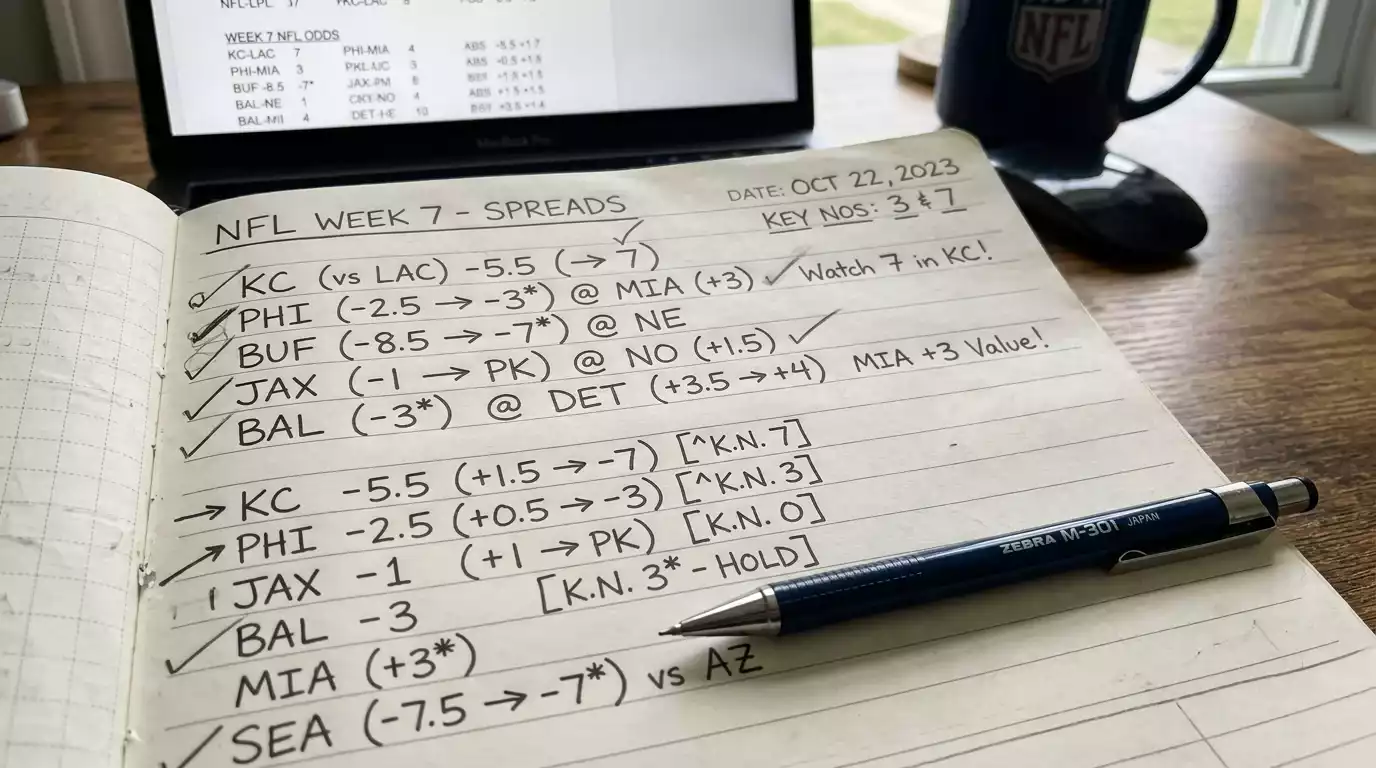
What this means practically is that spreads of -3, +3, -7, +7 and the half-points around them (2.5, 3.5, 6.5, 7.5) carry disproportionate weight. Getting the right side of 3 — the difference between -2.5 and -3.5, for instance — can swing your season-long results by several percentage points in win rate. Secondary key numbers worth knowing are 6, 10, and 14, though their frequency is lower.
The Half-Point That Pays
Suppose you like Team A at -3 (1.91). You see another bookmaker offering -2.5 (1.83). The odds are slightly worse at the second book, but you’re buying through the most important number in the sport. If the game lands on exactly 3 — which it does about 15% of the time — the -2.5 bet wins and the -3 bet pushes. Over 100 such bets, that difference alone generates meaningful profit.
This is precisely why spread betting strategy isn’t just about picking the right side — it’s about picking the right number. Timing your bet to land on the favourable side of a key number is one of the lowest-effort, highest-impact edges available to any bettor, and it costs nothing but patience and access to more than one bookmaker.
The 2025 season reinforced something I’ve tracked for years: favourites cover the spread at a rate well below 50%. That’s a significant drop from 2024, when they covered at 53.3%. If you’re blindly backing favourites because “they’re the better team,” the data is working against you in most spots. The spread exists to equalise — and most seasons, it leans slightly towards the underdog side of the ledger.
Line Shopping: Finding the Best Price Across UK Books
Here’s a confession that still embarrasses me: for my first three seasons, I used a single bookmaker for every NFL bet. One account, one set of odds, zero comparison. I was, in effect, walking into the same shop every week and paying whatever price was on the tag without checking the shop next door. The moment I opened accounts at three additional UK-licensed bookmakers and started comparing lines before placing anything, my results improved by roughly two percentage points in ROI over a full season. No new analytical insight. No model. Just shopping.
Line shopping is the practice of comparing odds across multiple bookmakers before committing your stake. It sounds tedious. It takes about ninety seconds per bet. And it’s one of the few edges in sports betting that requires absolutely no predictive skill — you’re simply ensuring you get paid more when you’re right.
| Factor | Single Bookmaker | Line Shopping (3+ Books) |
|---|---|---|
| Spread on same game | -3.5 at 1.91 | -3 at 1.87 (better number) |
| Moneyline underdog | 3.00 | 3.20 (better payout) |
| Totals line | O 44.5 at 1.91 | O 44.5 at 1.95 (less juice) |
| Season-long impact | Baseline ROI | +1 to 3% ROI improvement |
The differences look marginal on any single bet. A payout of 1.91 versus 1.95 on a GBP 50 stake is a difference of GBP 2. But compound that across 150-200 bets in a season and you’re talking about hundreds of pounds in additional value — or, more accurately, hundreds of pounds you stopped handing to the bookmaker’s margin.
In the UK, line shopping is particularly effective because the competitive landscape of UKGC-licensed bookmakers means odds can vary meaningfully across platforms — especially on NFL markets, which are less liquid than Premier League football and therefore less tightly priced. Open the same game on three or four apps, compare, and bet the best number. No software required.
Line shopping compounds with key number awareness. If you know that 3 and 7 are the margins to care about, and you’re actively scanning for the best number across multiple books, you’re stacking two edges on top of each other. Neither is glamorous. Together, they’re one of the most reliable long-term profit drivers available.
Bankroll Management That Survives a 17-Week Season
I’ve watched three different people in my circle lose their entire NFL betting bankroll before Week 8. Not because their picks were awful — they were actually running at about 49% ATS, which is close to the break-even zone. They lost because they sized their bets like every game was the Super Bowl. One bad Sunday wiped out weeks of grinding. The problem was never selection. It was structure.
Bankroll management is the most talked-about and least practised discipline in sports betting. Everyone knows they should do it. Almost nobody actually commits to a system and sticks with it when the pressure hits. Here’s the framework I use, stripped down to what actually matters.
The Unit System in Practice
Start with a bankroll you can genuinely afford to lose — let’s say GBP 1,000. Divide it into units. A standard approach is 1 unit = 1-2% of your total bankroll, so 1 unit = GBP 10-20.
Standard bet: 1 unit (GBP 10-20). Strong conviction: 1.5 units. Maximum bet (rare, maybe 3-5 times per season): 2 units.
Never, under any circumstances, should a single bet exceed 3% of your current bankroll. If your bankroll drops to GBP 800, your unit drops to GBP 8-16. If it grows to GBP 1,200, your unit rises to GBP 12-24. The system scales with your results, automatically reducing risk during losing streaks and increasing exposure during winning runs.
The maths behind this matters. At that 52.38% break-even threshold, a bettor hitting 55% — which is elite — will still face losing streaks of five, six, even eight bets multiple times per season. If your units are too large, one bad Sunday ends your season.
Pre-Season Bankroll Setup
- Define your total season bankroll in pounds — money you will not need for any other purpose
- Set your standard unit at 1-2% of that bankroll
- Establish a maximum bet size (never above 3% of current bankroll)
- Choose your adjustment frequency: weekly or every four weeks
- Write down your stop-loss threshold — the point at which you reduce units or pause betting entirely
- Commit to recording every bet with stake, odds, and outcome from day one
The Kelly Criterion — a staking formula that sizes bets according to your perceived edge — is worth understanding but dangerous in practice without accurate probability estimates. Most bettors overestimate their edge, which means full Kelly sizing leads to catastrophic over-betting. If you want to explore Kelly, use a fractional version (quarter-Kelly or half-Kelly) and accept that it’s only as good as your probability inputs. For a full breakdown of Kelly staking, variance modelling, and drawdown recovery, the bankroll management guide walks through the calculations with real GBP examples.
The bottom line is brutally simple: if you can’t survive a 10-bet losing streak — and you will hit one eventually — your unit size is too large. Everything else in this guide is useless without this foundation in place first.
Advanced Metrics: Using DVOA, EPA and PFF to Spot Value
A friend of mine backed the New England Patriots to cover every home spread in the first half of the 2025 season. His reasoning was pure gut: “They looked better in preseason, the new coaching staff seems sharp.” He happened to be right, but not for the reasons he thought. The Patriots’ EPA per play had jumped from -0.095 to +0.119 between seasons — a swing of +0.214, the second-largest improvement in the entire league. The data saw what his eyes only sensed. That’s the difference between being lucky and being informed.
DVOA (Defence-adjusted Value Over Average) measures a team’s efficiency on every play, adjusted for opponent quality and game situation. EPA/play (Expected Points Added per play) quantifies how much each snap changes a team’s expected scoring output. PFF grades evaluate individual player performance on every snap, independent of box-score stats. Together, these three metrics provide a view of team quality that traditional statistics — yards, points, turnovers — cannot match.
Most NFL betting guides mention these metrics by name and move on. That’s useless. What matters is how to apply them to an actual betting decision.
DVOA tells you whether a team is genuinely good or merely the beneficiary of a soft schedule. A team with a strong record but mediocre DVOA has been winning games they “shouldn’t” — and regression is coming. The market tends to overweight win-loss record and underweight efficiency metrics, which creates exactly the kind of gap you want to exploit.
EPA per play is the metric I lean on most for game-specific analysis. It captures the true impact of each snap, weighted by game context. A quarterback who throws for 300 yards in a blowout loss registers very differently in EPA than one who throws for 220 yards in a tight, efficient victory. I compare offensive EPA per play, defensive EPA per play allowed, and the differential — over rolling four-to-six-week windows, because recent form matters more than September data when you’re handicapping in December.
DVOA
Best for season-long team evaluation and schedule-adjusted rankings. Helps identify regression candidates — teams whose record doesn’t match their efficiency.
EPA/play
Best for game-specific matchup analysis. Use rolling 4-6 week windows. Offensive and defensive splits reveal which side of the ball is driving results.
PFF Grades
Best for player-level analysis and prop bets. Individual grading captures performance invisible to box scores — offensive line play, coverage grades, pressure rates.

Jason Ziernicki, founder of Cleatz, captured the principle well: “What happened to home-field advantage over 30 years can only be described as transformational. But certain stadiums maintained significantly stronger advantages, which told us specific environmental factors were still at play.” The same holds for metrics: the aggregate tells you the trend, but the granular data — specific matchups, specific weeks — is where actionable edges live.
PFF grades are most useful for player props and for evaluating position-specific matchups that aggregated team stats miss entirely. An offensive line grading poorly in pass protection facing a top-five pass rush tells you more about a quarterback’s day than any team-level metric can. The free versions of these data sources — available through sites that publish weekly DVOA rankings, EPA charts, and PFF summaries — are more than enough to build an edge. For a detailed walkthrough of building a multi-metric approach and applying it to real games, the advanced metrics betting guide goes considerably deeper.
The Decline of Home-Field Advantage — and What It Means for Your Bets
For decades, the rule of thumb was simple: add three points to the home team’s spread. That’s what oddsmakers did, that’s what bettors assumed, and it worked well enough when home teams were winning 60% of their games with an average margin of 3.6 points. But that world is gone. Home-field advantage in the NFL has collapsed by 62% since the 1990s. Home teams now win just 53% of games with an average margin of 1.4 points. The old three-point adjustment has quietly been halved — oddsmakers now bake in roughly 1.5 points for home field, and even that might be generous.
In 2024, home teams posted a record of 127-125-1 — one of the worst home-field performances in modern NFL history outside the pandemic-affected 2020 season. The “home-field advantage” was, statistically, almost nonexistent.
Billy Walters has been hammering this point for years: “The actual average home-field advantage, taking into account every NFL game from 1974 to 2022, is closer to 2.5 points. In addition, the home-field advantage over the last four years of NFL football is actually less than 1 point.” When the most successful sports bettor in history tells you a number is wrong, it’s worth listening.
The causes are structural and unlikely to reverse. Improved travel means away teams arrive fresher. Extensive film study reduces schematic surprises. Rule changes favouring offences have made crowd noise less impactful. And the league’s parity mechanisms — salary cap, draft, free agency — compress the talent gap, making home-field a smaller variable overall.
| Era | Home Win Rate | Average Home Margin | Implied Spread Adjustment |
|---|---|---|---|
| 1990s | 60% | 3.6 points | ~3 points |
| 2020s | 53% | 1.4 points | ~1.5 points |
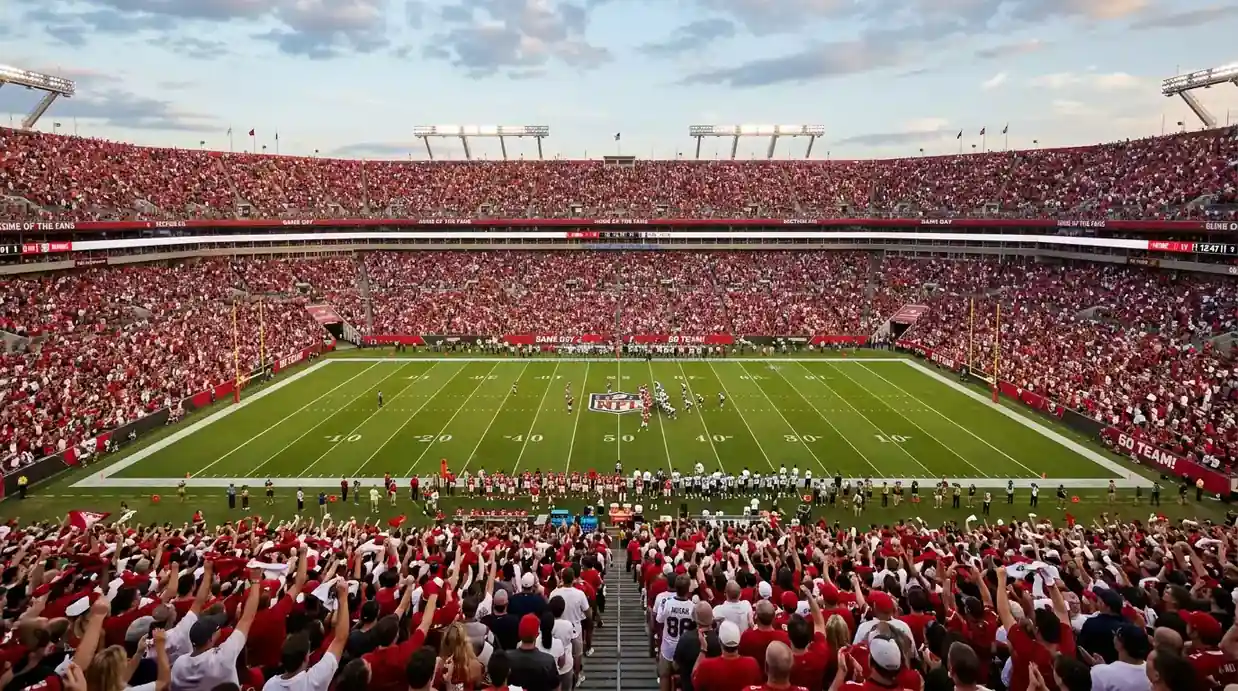
But here’s the nuance that separates a blunt “home-field doesn’t matter” take from something you can actually use: not all stadiums are the same. Six venues maintained home win rates above 65% between 2020 and 2024 — Kansas City and Buffalo at 78.9%, San Francisco at 73.3%, New Orleans at 68.9%, Baltimore at 68.4%, and Minnesota at 65.5%. These are outliers driven by specific environmental factors: altitude, extreme cold, dome acoustics, or fan cultures that genuinely affect opponent performance. If you’re betting a road team into Arrowhead or Orchard Park in January, the generic “1.5 points for home field” underestimates the reality.
For UK bettors, the application is straightforward: stop treating home-field advantage as a default three-point gift. Evaluate it stadium by stadium, matchup by matchup. A warm-weather team travelling to a cold outdoor stadium in December is a different proposition from a neutral-site feel in a climate-controlled dome. Academic research in the Journal of Quantitative Analysis in Sports supports this granular approach, finding that while the NFL average sits around 2.5 points, the variance between venues is enormous.
In-Play NFL Betting: Timing, Triggers and Traps
The first time I placed a live NFL bet, I was chasing. Down two units on the early Sunday games, I saw a team I liked trailing by ten in the third quarter, grabbed a live spread at a juicy number, and told myself it was a “calculated move.” It wasn’t. It was reactive, emotional, and it lost. The second time I placed a live bet, I had a pre-written note in front of me: “If Team X falls behind by 7+ in the first half against a bottom-ten defence, take the live spread.” That one hit. The difference wasn’t luck — it was having a framework before the game started.
In-play betting now accounts for a growing share of all NFL wagering. Roughly 48% of bettors still prefer pre-match, but 25% focus primarily on live markets — and the proportion climbs each season. Paddy Aherne, Head of Trading at one of the major Dublin-based operations, has noted the strategic importance of managing the full NFL weekend cycle, allowing traders to surface markets faster and leverage pricing opinions more effectively. Translation: bookmakers are investing heavily in live NFL pricing because the margins are higher and the public is less disciplined.
Do
- Define your live betting triggers before kickoff — specific game situations that create value
- Focus on momentum overreactions: turnovers, early scoring runs, and special teams mishaps move live lines further than the actual impact warrants
- Target halftime markets — the break gives you time to reassess without the pressure of real-time odds movement
- Use live betting to hedge pre-match positions when the game flow confirms your original thesis is in trouble
Don’t
- Chase losses by diving into live markets after a bad pre-match result — this is the single most expensive habit in live betting
- Bet live without a plan: if you didn’t identify potential live spots during your pre-game research, stay out
- Trust your reaction speed against the algorithm — live odds are priced by models that update faster than you can click
- Over-bet the fourth quarter: late-game volatility feels exciting but the markets tighten dramatically as information increases
The structural edge in live NFL betting comes from information asymmetry in the moments immediately after game-changing events. When a quarterback throws a pick-six, the live spread swings aggressively — often more than the actual probability shift warrants, because the algorithm is calibrated for speed, not precision. If you’ve done your homework and know the intercepting team’s defence is actually mediocre and the turnover was an outlier, that overcorrection is your window.
Live betting is not a substitute for pre-match analysis. It’s an extension of it. The bettors who profit from in-play markets are the ones who did their research before kickoff and are waiting for specific scenarios to unfold — not reacting to whatever happens to be on screen.

For UK punters, the practical challenge is timing. Sunday early games kick off at 6pm UK time, the late afternoon window starts at 9:05pm or 9:25pm, and Sunday Night Football doesn’t finish until well past midnight. If you’re watching from the UK and betting live, fatigue and late-night decision-making are genuine factors. I’ve made some of my worst live bets after 11pm on a Sunday, and I don’t think that’s a coincidence. A full breakdown of quarter-by-quarter timing windows, halftime strategies, and platform-specific lag issues is in the live betting tips guide.
Closing Line Value: The One Metric That Proves You Have an Edge
Ask most bettors how they measure success and they’ll tell you their win rate. “I’m hitting 56% this season.” Sounds impressive. But here’s a question I always follow up with: are you beating the closing line? Usually, silence. Win rate over a single season is a noisy, unreliable indicator — a 56% bettor can easily be a 50% bettor on a hot streak. Closing line value, or CLV, is the metric that cuts through the noise.
CLV in Action
You bet Team A -3 at 1.91 on Wednesday. By Sunday kickoff, the line has moved to Team A -4.5 at 1.91. The market — which aggregates millions of pounds of sharp and recreational money — closed at a number worse than the one you got. You captured 1.5 points of closing line value. Whether this particular bet wins or loses, the fact that you consistently get better numbers than the closing line is the strongest evidence that your process has an edge.
Strategy Toolkit
NFL Strategy Toolkit
Three edges the data actually supports: beating the closing line, pricing home field the way it really plays, and building a line from efficiency metrics.
Win rate is noisy; closing line value isn’t. If you consistently get a better number than the market closes at, you have a real edge — even before the results show it. Compare what you took to the close.
Track this from your first bet: record the odds (or number) you take and the closing line at the same book. A losing month with positive CLV is a process that pays off; a winning month with negative CLV is borrowed time.
The old “+3 for home field” is dead — the league average is now about 1.5 points. But a handful of venues never lost their edge. Pick the home stadium to price it properly.
Home-win rates are 2020–24. Venue values are estimates relative to the ~1.5-point generic adjustment the market now uses — a guide to where the line under- or over-rates home field, not a guaranteed number.
EPA per play captures team quality the box score misses. Enter each side’s offensive and defensive EPA (rolling 4–6 weeks works best) to build a fair line and compare it to the market.
A simplified model (≈63 plays/team, home field ±1.5 pts). It turns efficiency into a number you can compare to the line — not a finished projection. Use venue-specific home field from the Home Field tab for fortress stadiums.
The closing line is the most efficient line the market produces. It incorporates all available information — injury news, weather updates, sharp money, public betting patterns — right up to the moment of kickoff. Beating it consistently means you’re identifying value before the market does, which is the definition of a profitable long-term approach. CLV-positive bettors demonstrate returns two to three times higher than those who focus solely on win rate. That’s not a small difference. It’s the gap between a hobby and a genuine edge.
If you’re consistently getting better odds or better numbers than the closing line, you have a real edge — even if short-term results don’t reflect it yet. If you’re consistently on the wrong side of the closing line, no hot streak will save you in the long run. Track CLV from your very first bet.
The practical challenge for UK bettors is access. US-focused platforms make it easy to pull closing lines; UK bookmakers don’t always publish them transparently. The workaround: record the odds you take when you place your bet, then record the odds at the same bookmaker just before kickoff. I keep a simple spreadsheet column for this — thirty seconds per bet, and it’s the most valuable data point in my tracking log.
If you take one thing from this section, let it be this: stop judging your betting by results alone. A losing month with strong CLV is a process that will pay off. A winning month with negative CLV is borrowed time.
Seven Costly Mistakes UK NFL Bettors Keep Making
Over nine years of analysing NFL betting markets from the UK, I’ve made most of these mistakes myself. The list below isn’t theoretical — it’s a catalogue of the errors I see most frequently, each one costing real money that a simple adjustment could save.
Do
- Limit accumulators to 5-10% of weekly stakes. BetBuilder bets now represent 34% of NFL volume at some UK bookmakers — bookmakers promote them because the margins are enormous. Billy Walters has been direct: parlays and teasers are fun, but you cannot win on them over time. The house edge compounds with every leg.
- Open accounts at three or more UKGC-licensed bookmakers and compare lines on every bet. One account means one set of odds and zero leverage.
- Track closing line value from day one. Most UK bettors don’t know what CLV is, let alone measure it — and without it, you’re judging process by outcomes that take hundreds of bets to stabilise.
- Treat home-field advantage as a variable, not a constant. The 60% home-win era is over. Adjust for the specific stadium and matchup.
Don’t
- Bet every game. There are 272 regular-season games. The sharpest bettors I know pass on more games than they bet. If you can’t articulate a specific edge, sit it out.
- React to narratives instead of data. “They always play well after a bye” feels true because it’s memorable. Check the numbers before you believe the story.
- Skip the tracking log. If you’re not recording and reviewing your bets monthly, you’re repeating whatever you did last week — good or bad — with no feedback loop.
The single most expensive mistake is the one you make repeatedly without realising it. Tracking your bets is the only way to identify your personal patterns — the mistakes that cost you most may not be the ones you expect.
How to Track Your NFL Bets and Measure Real Performance
I know a bettor who went an entire season — 18 weeks of picks — believing he was profitable. He felt profitable. He remembered the big wins, the clever underdogs, the live bet that landed in overtime. Then he sat down in February and actually totalled up his accounts. He was down 14% on the season. The wins were vivid. The losses were forgotten. That’s not a character flaw — it’s how human memory works. Tracking is the antidote.
Essential Fields for Your NFL Betting Log
- Date and week number
- Game (teams and kickoff time)
- Bet type (spread, moneyline, total, prop, accumulator)
- Selection and line (e.g., Team A -3.5)
- Odds at time of bet (decimal)
- Stake in pounds
- Bookmaker used
- Result (win, loss, push, void)
- Profit/loss in pounds
- Closing line (odds or spread at kickoff)
- CLV (difference between your line and the closing line)
That looks like a lot of columns. In practice, it takes about sixty seconds per bet, and most of it is copy-paste from your bet slip. The closing line column requires one extra check before kickoff — note what the line has moved to since you placed your bet.
As I covered in the CLV section, the closing line is your most reliable feedback signal — and it stabilises far faster than win rate. If you’re four weeks into a season and your CLV is negative across 30 bets, that’s actionable information right now.
Review your log weekly for CLV trends and monthly for ROI by bet type. Most bettors discover they have one or two profitable bet types and several that consistently leak money. The monthly review is where you identify which categories to expand and which to cut — and that pruning process is worth more than any individual pick.
A basic spreadsheet is all you need. No paid software, no subscription service. The act of recording forces a moment of reflection before each bet: is this bet consistent with my strategy, or am I deviating? That friction alone reduces impulsive bets. Over a full season, the discipline compounds in ways that are difficult to appreciate until you’ve done it and seen the data tell a story your memory never would have.
Responsible Gambling: Protecting Your Bankroll and Your Wellbeing
I’ve written thousands of words in this guide about finding edges, managing bankrolls, and beating the closing line. None of it matters if betting stops being something you enjoy and starts being something you need. That transition happens gradually, often invisibly, and I’ve seen it affect sharp, disciplined people — not just reckless ones.
The numbers are worth sitting with: 2.7% of UK adults — roughly 1.4 million people — experience problems with gambling. That figure has held steady since 2023 despite the market growing. Andrew Rhodes, Chief Executive of the UK Gambling Commission, has urged operators to use the available evidence to consider the risks within their own customer bases. The same principle applies to individuals. Consider your own risk honestly.
Every UKGC-licensed bookmaker is required to offer deposit limits, loss limits, and cooling-off periods. Use them. Setting a weekly deposit limit before the season starts isn’t a sign of weakness — it’s the same principle as unit sizing applied to your overall gambling spend. If your bankroll management framework is sound, these limits should simply mirror what you’ve already planned.
The 25-34 age group has the highest gambling participation rate in the UK outside of the lottery — 35% at the end of 2025. If you’re in this demographic and betting on the NFL, you’re in the statistical peak of engagement. Being aware of that context matters.
Warning signs don’t arrive with a label. They look like betting more than you planned, chasing losses with bigger stakes, or feeling anxious when you’re not betting. If any of those resonate, the resources exist: GamStop for self-exclusion across all UK-licensed sites, GamCare for confidential advice, and the National Gambling Helpline for immediate assistance. These aren’t last-resort options. They’re tools, available for anyone who recognises they’d benefit.
Betting on the NFL should be an enhancement to watching the sport, not a replacement for enjoying it. If a Sunday of football feels ruined because your bets didn’t land, something has shifted. The best bettors I know are the ones who can watch a game they’ve wagered on, lose, and still appreciate a great defensive stand or a perfectly thrown deep ball. That relationship with the sport is worth protecting more than any edge.
Frequently Asked Questions About NFL Betting Strategies
What is the best NFL betting strategy for beginners?
Start with single straight bets — spreads or totals — rather than accumulators. Set up a bankroll with clear unit sizing (1-2% per bet), open accounts at three or more UK bookmakers for line shopping, and record every bet in a spreadsheet. The biggest edge a beginner can develop isn’t picking winners — it’s building a process that survives losing streaks and improves over time.
How does point spread betting work in the NFL?
The bookmaker assigns a margin-of-victory handicap to equalise both sides. If a team is favoured at -3.5, they need to win by 4 or more points for a spread bet to pay out. The underdog at +3.5 can lose by up to 3 and still cover. At UK bookmakers, this appears as a handicap market with decimal odds. The key strategic element is understanding key numbers — especially 3 and 7 — which dominate NFL scoring margins.
Is it better to bet NFL underdogs or favourites?
Underdogs hold a slight edge against the spread over time. In 2025, favourites covered just 47.8% of spreads despite winning 65.9% outright. Public money leans towards favourites, which can inflate the line beyond true value. But blindly backing every dog isn’t a strategy either — the edge is in identifying specific spots where situational factors favour the underdog.
How important is line shopping for NFL bets?
It’s one of the highest-impact habits available, requiring zero analytical skill. Comparing odds across three or four UKGC-licensed bookmakers typically adds 1-3% to season-long ROI. NFL markets at UK bookmakers show wider price variation than Premier League football because they’re less liquid, making the gains from shopping even more pronounced.
What are the key numbers in NFL spread betting?
The two critical numbers are 3 (field goal) and 7 (touchdown plus extra point). About 15% of NFL games are decided by exactly 3 points, and another 9-10% land on 7. Spreads at these numbers carry disproportionate importance, and getting the right side through line shopping or timing can meaningfully improve your results. Secondary key numbers include 6, 10, and 14.
How do I manage my bankroll for NFL betting?
Define a season bankroll you can afford to lose entirely. Set your standard unit at 1-2% of that total — a GBP 1,000 bankroll means GBP 10-20 per bet. Never exceed 3% on a single wager. Adjust unit size periodically based on your current balance, which automatically reduces risk during losing runs. The goal is surviving the inevitable losing streaks that even elite bettors face.
What common mistakes should NFL bettors avoid?
The most expensive mistakes are structural: over-reliance on accumulators, using a single bookmaker, ignoring closing line value, betting too many games, and failing to track results. Narrative-driven betting — backing teams based on stories rather than data — is another persistent leak. The fix is discipline: fewer bets, more bookmakers, a tracking log, and a willingness to pass on games without a clear edge.
Created by the ”nfl Betting Strategies” editorial team.