NFL Thursday Night Football Betting: Short-Week TNF Trends
 Available in US
Table of Contents
- Short-Week Dynamics: Exploiting Under-Heavy TNF Totals
- The Short-Rest Effect: How Four-Day Turnarounds Change Game Quality
- TNF Totals: Why Unders Hit More Often on Short Weeks
- Home vs. Away Teams on Thursday: Does Rest Asymmetry Matter?
- Late-Night Kick-Off: Live Betting TNF From the UK
- TNF as Part of Your Weekly Betting Rhythm
Short-Week Dynamics: Exploiting Under-Heavy TNF Totals
Thursday Night Football occupies a strange position in the NFL calendar. For American audiences, it’s a midweek appetiser — a single game that breaks up the wait between Sundays. For UK punters, it’s a late-night event that kicks off at 1:15 AM GMT, which means you’re either staying up or waking up to check results. For bookmakers, it’s a game set on compressed timelines with thinner data, less public attention pre-match, and unique scheduling dynamics that create a subtly different betting environment from Sunday’s main slate.
Roughly 48% of bettors prefer pre-match wagering over live betting, and that preference shapes how TNF lines are priced. The pre-match market for Thursday games is thinner than Sunday markets because the betting public has less time to form opinions between the previous Sunday and Thursday’s kickoff. Sharper lines come from heavier volume, and lighter volume means softer lines. For bettors willing to put in analysis time on a compressed schedule, Thursday games offer a modest structural edge.
The Short-Rest Effect: How Four-Day Turnarounds Change Game Quality
The defining feature of Thursday Night Football is the short rest period. Teams playing Sunday and then again on Thursday have only four days to recover, travel, and prepare. Compare that to the standard six-day turnaround for Sunday-to-Sunday games, and the physical and strategic disadvantage is clear.
The short-rest effect manifests in several measurable ways. Injury rates are higher — players haven’t fully recovered from Sunday’s contact. Offensive complexity is lower — coaching staffs have less time to install game-specific schemes, so teams lean on their base packages rather than creative formations. Execution is sloppier — penalties increase, mental errors rise, and the pace of play often feels a half-step slower than a typical Sunday game.
Home-field advantage in the NFL has declined dramatically over the past three decades, falling from a 60% home win rate in the 1990s to approximately 53% in the 2020s. But on Thursday nights, the rest asymmetry can amplify whatever home advantage remains. The home team avoids travel, sleeps in its own beds, and typically has a marginal preparation advantage because it doesn’t lose hours to airports and hotels. When one team played on the road the previous Sunday and then has to travel again for Thursday, the cumulative fatigue compounds beyond what a simple “short rest” label captures.
The market is aware of the short-rest effect, and oddsmakers adjust for it. But the adjustment is generic — typically half a point to a point toward the home team or the team with a rest advantage. The market doesn’t always distinguish between a team that played a gruelling overtime game on Sunday and a team that cruised to a blowout win and pulled its starters in the fourth quarter. Both are technically on “short rest,” but the physical toll is vastly different. If you can identify the severity of the previous game’s physical impact, you can sometimes spot where the generic market adjustment falls short.
TNF Totals: Why Unders Hit More Often on Short Weeks
The most reliable TNF betting angle is the under on game totals. The structural reasons are clear and reinforcing: reduced offensive preparation limits creative play-calling, physical fatigue slows the pace of play, higher penalty rates create drive-killing false starts and holding calls, and conservative coaching decisions (fewer deep shots, more check-downs, more running plays) compress the scoring range.
Historically, TNF unders have covered at a rate above the 52.38% breakeven threshold for standard -110 bets. The edge isn’t enormous — we’re talking about 53-55% in most samples — but it’s persistent because the structural factors that cause lower scoring are baked into the Thursday format and unlikely to change as long as teams play on short rest.
The under lean is strongest in the early weeks of the season (Weeks 2-5), when teams are still installing their offensive systems and the short week limits how much new material the coaching staff can introduce. By mid-season, teams have established their offensive identity and can operate on a shorter preparation timeline more effectively. Late-season TNF games, particularly those in cold-weather outdoor venues, see the under lean return because weather compounds the short-rest effect.
One exception to the under trend: when both teams had a bye week before the Thursday game. The NFL schedule occasionally features a Thursday matchup where one or both teams come off a bye rather than a Sunday game. In these cases, the short-rest disadvantage is eliminated, and the totals behave more like a standard Sunday game. Always check the previous-week schedule before defaulting to the under.
Home vs. Away Teams on Thursday: Does Rest Asymmetry Matter?
Not all Thursday games feature equal rest for both sides. In most TNF matchups, both teams played the previous Sunday. But occasionally one team had a Monday Night Football game just three days before Thursday, or one team had the previous week’s bye. These asymmetries create specific betting angles.
A team coming off Monday Night Football and playing on Thursday has only a three-day turnaround — the shortest rest period in the NFL. These teams have historically underperformed their expected output, and the market sometimes underadjusts because the focus is on the Thursday game itself rather than the Monday-to-Thursday timeline. If you spot a TNF matchup where one team played Monday and the other played Sunday, the rest differential is a full day, which in a sport where recovery time is measured in hours, is significant.
Conversely, a team coming off a bye week and playing on Thursday has had ten or more days of rest. This team has a massive preparation and recovery advantage that the market accounts for but sometimes underestimates. Post-bye teams on Thursday can install a more complex game plan than their short-rest opponents, creating a scheme advantage on top of the physical one. Back post-bye teams on Thursday more confidently than post-bye teams on Sunday, because the rest differential is amplified by the opponent’s compressed preparation.
Travel direction also matters on Thursday. A West Coast team travelling east for a Thursday game faces an effective kickoff time two hours earlier than their body clock, plus the recovery from cross-country travel, plus the short preparation window. The cumulative burden is severe. An East Coast team travelling west has a later effective kickoff time, which is generally easier to manage physiologically. I covered the broader travel and scheduling dynamics in the bye week and scheduling analysis, and the principles apply doubly on Thursdays.
Late-Night Kick-Off: Live Betting TNF From the UK
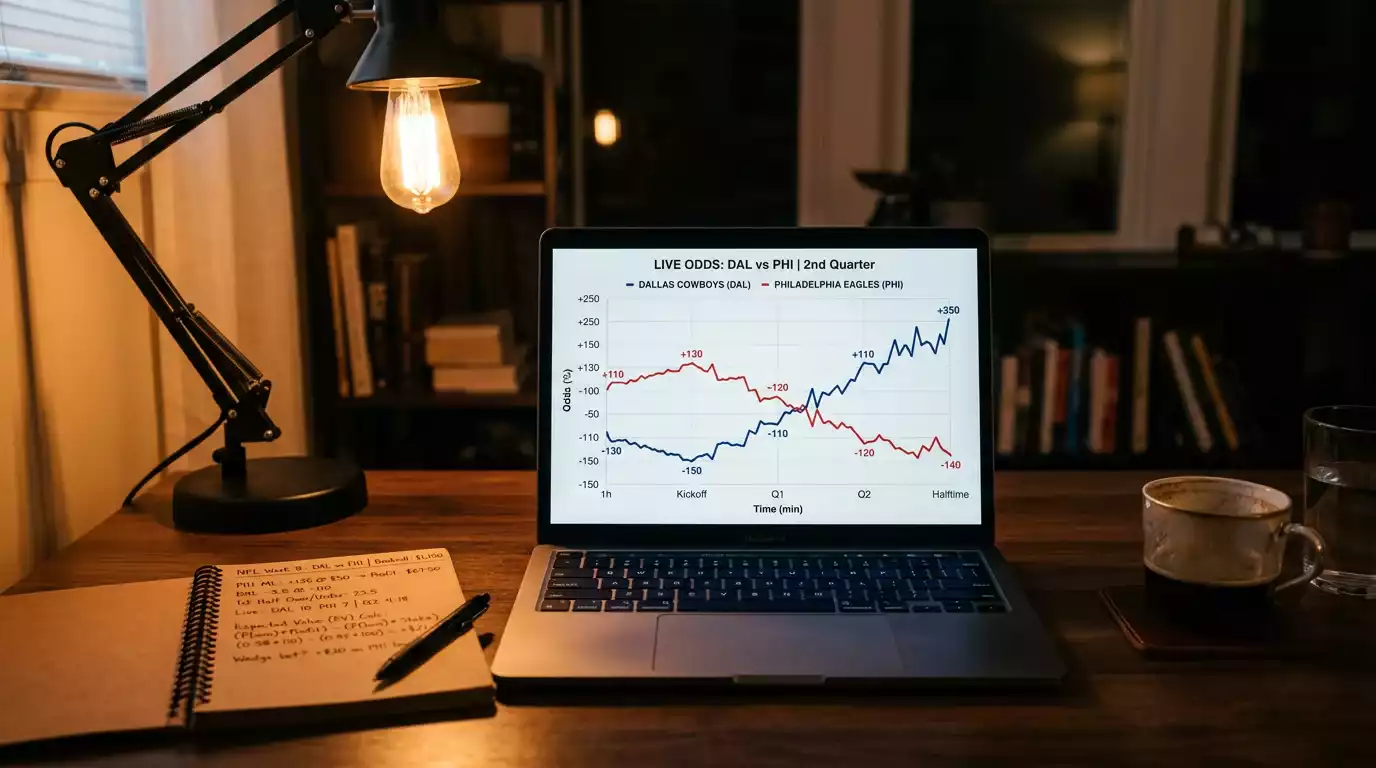
For UK punters, Thursday Night Football’s 1:15 AM GMT kickoff creates a practical question: is it worth staying up? From a pure betting perspective, TNF live markets are thinner than Sunday live markets, which means the in-game odds are less efficient and the potential for mispricing is higher. If you have the discipline to bet selectively and the stamina to stay alert past midnight, TNF live betting can be productive.
The key live betting angle on Thursday is the first-quarter adjustment. Because both teams are on short rest and operating from base offensive packages, the first quarter often produces lower scoring than the market’s in-game model expects. If the first quarter ends 3-0 or 0-0, the live total for the remainder of the game may still be set too high, reflecting an expectation that the offences will “warm up” as the game progresses. In TNF, the warming-up process is slower than on Sundays because the physical preparation was insufficient, and second-quarter scoring doesn’t always recover as quickly as the live model assumes.
If staying up until 4:00 AM isn’t realistic, consider placing your TNF bets pre-match and reviewing the results in the morning. The pre-match under lean and the rest-asymmetry angles don’t require live monitoring — they’re factors you can evaluate before kickoff and let play out while you sleep. Save your late-night live betting sessions for the games where you’ve identified a specific in-game trigger worth watching for.
TNF as Part of Your Weekly Betting Rhythm
Thursday Night Football sets the tone for each NFL betting week. Sharp bettors often use TNF as a calibration point: how did the market price the short-rest factors, and was the closing line accurate? The result of the Thursday game influences Sunday line movements indirectly — if a high-profile TNF favourite loses outright, the public’s confidence in that week’s other favourites may waver, softening spreads across Sunday’s slate.
For UK bettors managing a weekly betting process, TNF is best treated as a single-bet opportunity rather than a multi-bet event. Because there’s only one game, the temptation to over-bet — stacking the spread, total, and player props into a Thursday-specific accumulator — is real. Resist it. One well-researched position on the total or the spread, sized at your standard unit, is the disciplined approach. Use Thursday as information-gathering for Sunday rather than trying to force action on a game that may not present clear value.
Does the under hit more often on NFL Thursday Night Football games?
Yes, historically unders have covered at a rate slightly above the 52.38% breakeven threshold in TNF games. The structural causes are consistent: short-rest preparation limits offensive creativity, physical fatigue slows pace, penalty rates increase, and coaching decisions trend conservative. The under lean is strongest in early-season and late-season cold-weather TNF matchups, and weakest when one or both teams had a bye week before the Thursday game.
What time does Thursday Night Football kick off in the UK?
Thursday Night Football typically kicks off at 8:15 PM Eastern Time in the US, which translates to 1:15 AM GMT for UK viewers. During British Summer Time (late March to late October), the kickoff falls at 1:15 AM BST. Games usually conclude around 4:00-4:30 AM UK time.
Created by the ”nfl Betting Strategies” editorial team.