NFL Hedging Strategy: Hedging Calculations and Profit Locking
 Available in US
Hedging Mathematics: Calculating Optimal Risk Management Outcomes
The first time I hedged a futures bet, it felt like surrendering. I had a Super Bowl ticket at 15.00 that was alive in the conference championship round, and I placed a bet on the other side to guarantee profit regardless of the outcome. My mates called it “bottling it.” But 48 hours later, when my original team lost and the hedge paid out, that guaranteed profit felt a lot better than the zero I would have been staring at. Hedging isn’t about courage or cowardice. It’s about managing risk with numbers — the same discipline that makes the breakeven threshold of 52.38% on standard spread bets the foundation of every serious bettor’s framework.
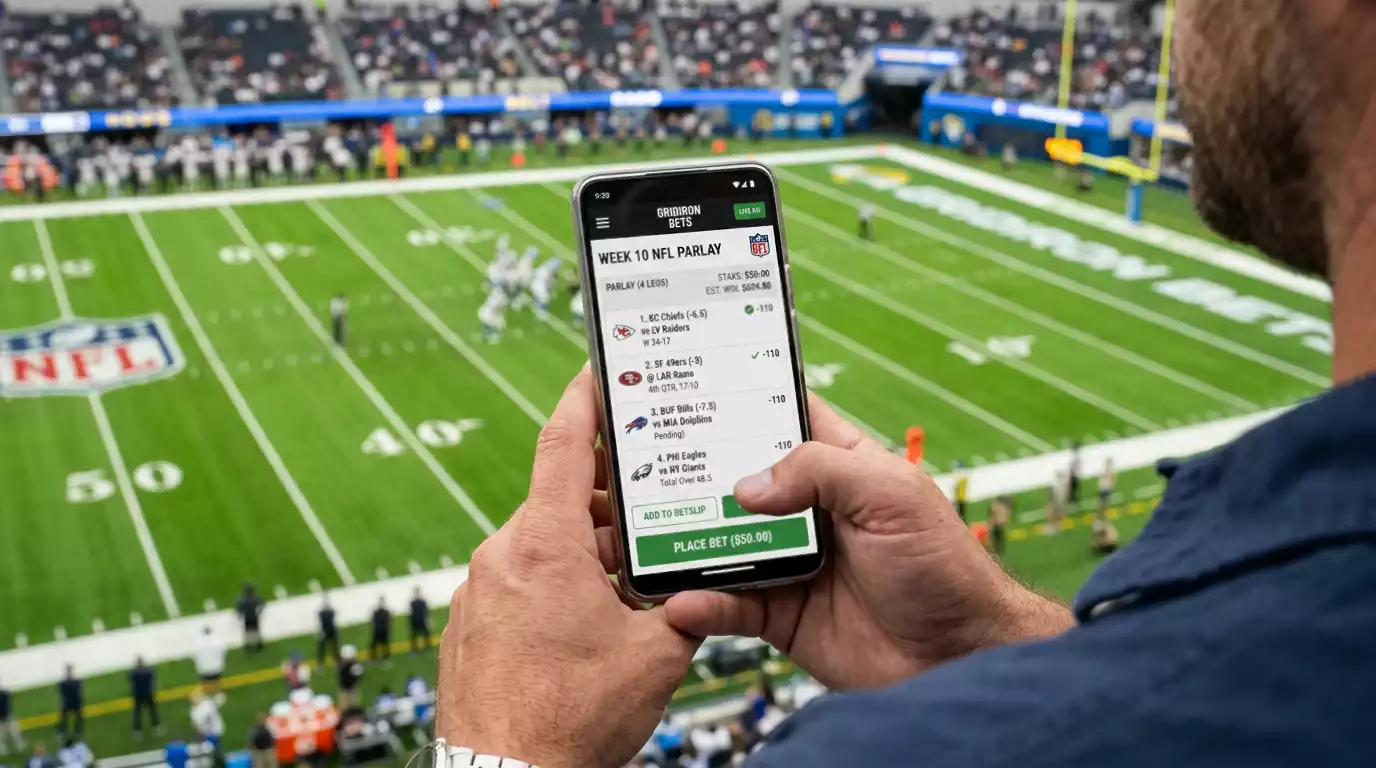
The hedging decision shows up in three common NFL scenarios: futures bets that reach the playoffs, accumulator legs where all but one have won, and live bets where your pre-match position is in profit mid-game. Each scenario requires the same mathematical framework but different practical considerations.
The Decision Framework: When Hedging Makes Financial Sense
Not every profitable position should be hedged. The maths only supports hedging when the guaranteed profit from the hedge exceeds the expected value of letting the original bet ride at full risk. Let me break that down.
Your original bet has an expected value: the probability of winning multiplied by the potential payout, minus the probability of losing multiplied by zero (since you’ve already paid the stake). If your Super Bowl future has a 25% chance of hitting and would pay 800 pounds on a 50-pound stake, the expected value of letting it ride is (0.25 x 800) – (0.75 x 0) = 200 pounds. Any hedge that guarantees less than 200 pounds is mathematically inferior to letting it ride.
But expected value isn’t the whole story. Utility matters. If that 50-pound bet represents 10% of your bankroll, the risk of losing it (75% probability) carries real consequences for your overall season performance. Hedging to lock in, say, 150 pounds gives you a certain profit that stabilises your bankroll even though the expected value of riding it out is higher. In betting, surviving to bet another week often matters more than maximising theoretical value on any single position.
My rule of thumb: if the original stake represents more than 5% of my current bankroll and the remaining probability of winning is below 40%, I hedge. If the stake is a small percentage and the probability is reasonable, I let it ride. The threshold shifts based on where I am in the season — early in the year, I’m more risk-tolerant because there’s time to recover. Late in the year, I’m more conservative because the season is ending.
The Hedge Calculation: A Step-by-Step Walkthrough
The formula for calculating the exact hedge stake is straightforward. I’ll walk through it with a real example using decimal odds, since that’s what UK bookmakers display.
Scenario: You placed 50 pounds on Team A to win the Super Bowl at 15.00 (implied probability 6.67%). Team A has reached the Super Bowl. The opposing team, Team B, is available at 2.10 on the moneyline for the game.
If Team A wins, your original bet pays: 50 x 15.00 = 750 pounds (gross return, 700 profit). If Team A loses and you don’t hedge, you lose the 50-pound stake.
To guarantee equal profit regardless of outcome, use this formula: Hedge stake = (Original potential payout) / (Hedge odds). Hedge stake = 750 / 2.10 = 357.14 pounds on Team B at 2.10.
If Team A wins: you collect 750 from the original bet but lose 357.14 on the hedge. Net profit: 750 – 357.14 – 50 (original stake) = 342.86 pounds. If Team B wins: you collect 357.14 x 2.10 = 750 from the hedge but lose the 50-pound original. Net profit: 750 – 357.14 – 50 = 342.86 pounds. Equal profit either way: 342.86 pounds guaranteed.
You don’t have to hedge for equal profit on both sides. You can hedge partially — putting a smaller amount on Team B to guarantee a modest profit on one outcome while preserving a larger payout on the other. Partial hedging is a compromise between full hedge and full ride, and it’s what I do most often. It reduces the downside without completely capping the upside.
For a partial hedge, decide your minimum acceptable profit if the hedge side wins, then calculate the stake needed to achieve that amount. If you want at least 100 pounds guaranteed if Team B wins: Hedge stake = (Desired minimum profit + Original stake) / (Hedge odds – 1). Hedge stake = (100 + 50) / (2.10 – 1) = 150 / 1.10 = 136.36 pounds. If Team B wins: (136.36 x 2.10) – 136.36 – 50 = 100 pounds profit. If Team A wins: 750 – 136.36 – 50 = 563.64 pounds profit. A partial hedge that guarantees 100 while leaving 563.64 upside.
Hedging NFL Futures: Playoff and Super Bowl Scenarios
Billy Walters described the setup in betting as one where most people have no chance of winning — zero. Futures are an exception when priced correctly, but they also create the most psychologically challenging hedging decisions. You’ve held a ticket for months. You’ve watched your team fight through a 17-game season. The emotional investment is enormous. And now you need to make a financial decision that your emotions want nothing to do with.
I’ve developed a staged approach to futures hedging that removes emotion from the equation. At each playoff round, I recalculate the expected value of the remaining ticket and compare it to the guaranteed profit from hedging. If the expected value exceeds the hedge by more than 30%, I let it ride. If the gap is less than 30%, I partially hedge. If the expected value equals or falls below the hedge, I fully hedge.
Concrete example: my team enters the divisional round at 3.50 to win the Super Bowl (28.6% implied probability). Original stake: 50 pounds at 15.00. Potential payout: 750. Expected value of riding: 0.286 x 750 = 214.50. A full hedge at this stage would guarantee roughly 180-200 (depending on available odds). 214.50 is only marginally higher than 200 — the gap is about 7%, well below my 30% threshold. I hedge partially, locking in 150 guaranteed while keeping upside if the team advances.
At the conference championship, I re-evaluate. If the team wins and reaches the Super Bowl, the original ticket is now worth far more and the hedge becomes the example I worked through above. If the team loses, the partial hedge from the previous round softens the blow.
Hedging Live Bets: Cash Out vs. Manual Hedge
Most UK bookmakers offer a “cash out” button on live bets and accumulators. It’s essentially a pre-calculated hedge offered by the bookmaker. The question is whether the cash-out price is fair.
In my experience, cash-out prices are consistently worse than what you’d get by hedging manually. The bookmaker builds a margin into the cash-out offer — typically 5-15% worse than the fair value of your position. They can do this because cash-out is convenient. One tap, instant settlement, no maths required. That convenience has a price, and you’re paying it.
The alternative: place a separate bet on the opposing outcome at the best available odds, using the hedge formula above. This requires a second betting account (or at least a second market on the same platform) and a few minutes of calculation. But the result is a better guaranteed profit than the cash-out button offers. I use cash-out only when the manual hedge isn’t practical — when the opposing market isn’t available, when the odds are moving too fast to calculate, or when the amount at stake is small enough that the convenience premium isn’t worth worrying about.
For NFL futures heading into the playoffs, always hedge manually. The amounts involved are large enough that the 5-15% difference between cash-out and manual hedging translates to tens or hundreds of pounds. That’s real money, and it takes five minutes of arithmetic to capture it.
How do I calculate the exact hedge stake for an NFL futures bet?
Use this formula: Hedge stake = Original potential payout / Hedge odds. For example, if your original bet pays 750 pounds and the opposing side is available at 2.10, the hedge stake is 750 / 2.10 = 357.14 pounds. This guarantees equal profit (342.86 pounds in this example) regardless of the outcome. For a partial hedge that preserves more upside on the original bet, decide your minimum acceptable profit if the hedge side wins and calculate: Hedge stake = (Desired minimum profit + Original stake) / (Hedge odds – 1).
Is it better to use a bookmaker’s cash-out feature or hedge manually?
Manual hedging almost always produces a better guaranteed profit than the cash-out button. Bookmakers build a margin of 5-15% into their cash-out offers, which means you’re paying a convenience premium for one-tap settlement. By placing a separate bet on the opposing outcome at the best available odds and using the hedge formula yourself, you capture that 5-15% difference. Use cash-out only when manual hedging isn’t practical — when the opposing market is unavailable, odds are moving too quickly, or the amounts involved are too small to justify the calculation time.
Written by the editors at nfl Betting Strategies.