NFL Betting in the UK: Bookmakers, Regulations and Market Odds
 Available in US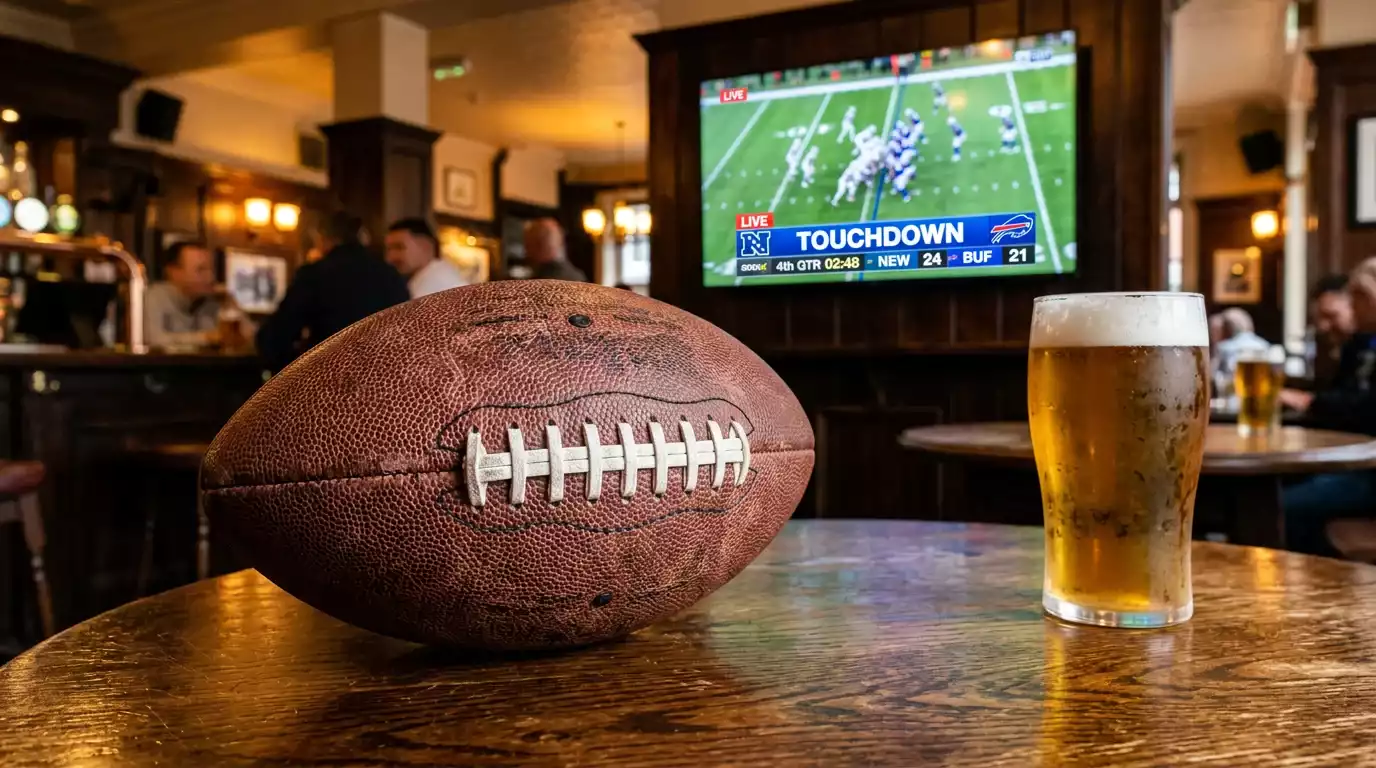
Table of Contents
- UK NFL Betting Growth: Exploiting Expanded Market Liquidity
- The UKGC Framework: What UK NFL Bettors Are Protected By
- Tax-Free Winnings and Other UK Advantages Over American Bettors
- Decimal vs. Fractional vs. American: Converting NFL Odds Fluently
- NFL Market Depth at UK Books: What’s Available and What’s Missing
- Kickoff Schedules in UK Time: Planning Your Betting Week
- Deposits, Withdrawals and Spending Limits on UK Platforms
- US Sportsbooks vs. UK Bookmakers: A Side-by-Side Comparison
- NFL Betting in the UK: Questions Answered
UK NFL Betting Growth: Exploiting Expanded Market Liquidity
Five years ago, if you told a room of UK punters that American football would become the third most popular betting sport among Paddy Power’s customer base — behind only football and horse racing — they’d have laughed you out of the pub. It was tenth in 2019. By 2024, it had vaulted seven spots. That trajectory isn’t slowing down.
The numbers behind the shift are striking. Britain accounts for roughly 3% of global NFL search traffic — a small-sounding figure until you realise it’s larger than Germany’s share, despite Germany hosting NFL games of its own. Active customers placing NFL bets at Paddy Power grew by 21% year on year, with overall NFL bet volume up 25%. The London games have been the accelerant: customers betting on the London fixtures specifically jumped 25%, with handle up 30%. As one industry spokesperson put it, the data reveals a remarkable surge in British enthusiasm for American football.
What does this mean for you as a UK bettor? Two things. First, the growing market is forcing UK bookmakers to invest in their NFL product — deeper markets, more prop options, better in-play coverage. Five years ago, finding a UK book that offered NFL player props beyond basic touchdown scorer markets was a challenge. Now, the major operators list rushing yards, receiving yards, passing completions and dozens of bet builder combinations for every Sunday slate. Second, more recreational money flowing into NFL betting creates more opportunities for informed bettors. When the pool of casual punters grows, the lines get shaded further toward public favourites, which widens the value on the other side for anyone doing serious analysis.
The UKGC Framework: What UK NFL Bettors Are Protected By
I’ve spent enough time reading American betting forums to appreciate something UK punters often take for granted: the regulatory framework here is vastly more protective than what exists in most US states. The UK Gambling Commission oversees every licensed operator, and the rules they enforce directly affect your experience as an NFL bettor.
The UK gambling market generates 16.8 billion pounds in annual gross gambling yield, with online betting, casino and bingo accounting for 7.8 billion of that — roughly 46% of the total market. That scale means the UKGC has both the incentive and the resources to regulate actively. Every bookmaker you use for NFL betting must hold a UKGC licence, which requires them to segregate customer funds (so your balance is protected if the operator goes bust), verify your identity before allowing significant withdrawals, and offer responsible gambling tools including deposit limits, loss limits and cooling-off periods.
Around 12% of British adults participate in betting — the most popular form of gambling after the National Lottery, level with scratch cards. That broad participation base is one reason the regulatory framework is so developed: betting is mainstream, and mainstream activities attract regulatory attention. For NFL bettors specifically, the key protections are: fair terms on promotions (no misleading bonus structures), transparent odds display, and mandatory links to self-exclusion tools like GamStop.
The practical benefit is peace of mind. When you place a spread bet on an NFL game through a UKGC-licensed operator, you know the operator is audited, your funds are ring-fenced, and you have a formal complaints pathway if something goes wrong. American bettors in newly legalised states don’t always have that certainty — regulatory frameworks vary wildly by jurisdiction, and some states are still working out the basics. The UK system isn’t perfect, but for an NFL bettor’s purposes, it’s one of the most mature consumer-protection environments in the world.
Tax-Free Winnings and Other UK Advantages Over American Bettors
Here’s a fact that makes every American bettor I speak to visibly annoyed: in the UK, your gambling winnings are completely tax-free. You could win 50,000 pounds on a Super Bowl futures bet and not owe HMRC a penny. In the United States, gambling winnings are taxed as ordinary income at the federal level, and most states stack a state tax on top. For a US bettor in New York, the combined marginal rate can exceed 50%. That’s not a rounding error — it’s a structural disadvantage that makes profitable betting significantly harder.
The reason UK winnings are untaxed is straightforward. Since 2001, the UK has levied a point-of-consumption tax on the bookmaker rather than the bettor. The operator pays 21% tax on their gross gambling yield, which they absorb as a cost of doing business. You, the punter, see the odds and the payout — and you keep whatever you win. This model has persisted through multiple governments and regulatory reviews, and there’s no serious political movement to change it.
For NFL spread bettors, the tax-free advantage amplifies your effective edge. A bettor winning at 54% against the spread in the UK keeps the full mathematical profit. The same bettor in the US might see 20-30% of that profit disappear to taxes, depending on their state. Over a multi-season career, the compounding difference is enormous. It’s one of the genuine structural edges of being a UK-based NFL bettor, and it costs you nothing to claim.
There’s one caveat. If you bet professionally — meaning it constitutes your primary income — HMRC could theoretically treat your profits as trading income. In practice, this almost never happens for individual sports bettors; the established legal precedent treats betting as a leisure activity. But if you’re at the point where NFL betting is generating a living wage, consult an accountant who specialises in gambling taxation.
Decimal vs. Fractional vs. American: Converting NFL Odds Fluently
Odds formats shouldn’t be a barrier to NFL betting, but I’ve seen enough confused direct messages to know they are. American resources quote NFL odds in the American format (+150, -110), UK books default to either decimal (2.50, 1.91) or fractional (6/4, 10/11), and you need to convert fluently because your analytical resources will use one format and your betting slip will use another.
The conversion logic is simple. American to decimal: if the American odds are positive (e.g., +150), divide by 100 and add 1, giving you 2.50. If negative (e.g., -110), divide 100 by the absolute value and add 1, giving you 1.91. Decimal to implied probability: divide 1 by the decimal odds (1 / 1.91 = 52.4%). Fractional to decimal: divide the first number by the second and add 1 (10/11 = 0.909 + 1 = 1.91).
I’ve already recommended switching your display to decimal odds and keeping it there. The reasoning bears repeating: decimal odds make implied probability calculation trivial (just divide 1 by the number), and they make line comparison between books instantaneous. When you’re comparing 1.87 vs. 1.91 vs. 1.95 across three bookmakers, the relative value is immediately visible. In fractional format — 87/100 vs. 10/11 vs. 19/20 — you’d need to convert each one before you could compare, and that friction slows you down at precisely the moment when speed matters.
One more tip: most US-focused NFL analytics and tipping sites present odds in American format. Train yourself to do the conversion automatically, or use a bookmarked calculator. The five seconds you spend converting -115 to 1.87 in your head is five seconds you’re not spending on whether the line is worth taking. Build the conversion into muscle memory and it becomes invisible within a few weeks of practice.
NFL Market Depth at UK Books: What’s Available and What’s Missing
Five years ago I’d have told you that UK bookmakers lagged American sportsbooks by a mile on NFL market depth. That gap has narrowed considerably, driven largely by the explosion in bet builder (same-game parlay) demand. The share of BetBuilder bets in total NFL wagering at Paddy Power climbed from 29% in 2023 to 34% in 2024 — a shift that forced operators to expand their NFL prop menus to feed the market.
Today, the major UK books offer a solid core of NFL markets: match handicap (spread), match result (moneyline), total points (over/under), first/last/anytime touchdown scorer, player yardage and reception props, quarter and half betting, and same-game parlay builders. On a flagship Sunday afternoon slate, the larger operators list 200+ markets per game. That’s approaching parity with the US books for the most popular matchups.
Where UK books still trail is on the margins. Alt-spread menus at US sportsbooks might offer 15-20 alternate lines per game; UK books typically offer 8-12. Niche props — things like “will there be a safety” or “exact total points scored” — are often available in the US but absent in the UK, or offered only on primetime games. Teaser markets, a staple of American NFL betting, remain rare at UK bookmakers; if your strategy depends on Wong teasers, you may struggle to find the right markets consistently.
The online betting sector in the UK generates 7.8 billion pounds in gross gambling yield — a figure that’s grown by over 900 million in a single year. That growth is pulling operator attention (and technology investment) toward sports betting markets, including American football. I expect the depth gap to continue closing over the next two or three seasons, particularly as more UK operators license American odds feeds and pricing models. For now, though, know the limits of your platform before building a strategy that depends on market types your bookmaker might not offer.
Kickoff Schedules in UK Time: Planning Your Betting Week
NFL betting from the UK means late nights and early evenings, and your weekly schedule should reflect that. Here’s the standard layout for a regular-season Sunday during the 2026 season, converted to GMT/BST.
The early window kicks off at 6:00 PM UK time (1:00 PM Eastern). This is the busiest slate, with up to eight games running simultaneously. The late afternoon window starts at 9:05 or 9:25 PM UK time (4:05/4:25 PM Eastern), typically featuring two to three games. Sunday Night Football begins at 1:20 AM Monday morning UK time (8:20 PM Eastern). Thursday Night Football kicks off at 1:15 AM Friday UK time. Monday Night Football starts at 1:15 AM Tuesday UK time.
In 2025, the NFL scheduled a record seven international games, three of them in London — at Wembley and Tottenham Hotspur Stadium. Those London fixtures typically kick off at 2:30 PM UK time, making them the only NFL games of the season you can watch at a reasonable hour without rearranging your sleep. I’ve covered the specific betting angles around London games separately, because the kickoff time, jet lag and crowd dynamics create a distinct set of edges.
My weekly routine looks like this. Lines open Sunday evening; I review them Monday morning. Tuesday through Thursday I do my analysis and place most of my pre-match bets. I watch the early Sunday evening window live, which gives me in-play opportunities on those games. The late window and Sunday Night Football I track via live scores if I’m not staying up — and I’ll only stay up if I have a specific in-play thesis on one of those games. Discipline about sleep matters: tired analysis is bad analysis, and placing a 2 AM bet because you’re bored and awake is not strategy.
One scheduling consideration that UK bettors overlook: the clock change. The UK switches between GMT and BST at different dates than the US transitions between Eastern Standard and Eastern Daylight Time. For two weeks in March and one week in November, the usual time offset shifts by an hour, which means kick-off times move relative to your UK clock. I’ve missed the start of games — and the best in-play windows — because I forgot about the clock mismatch. Mark the transition weekends in your calendar at the start of each season and adjust your alarms accordingly.
Deposits, Withdrawals and Spending Limits on UK Platforms
Every UKGC-licensed bookmaker is required to offer deposit limits, loss limits and session time limits. These aren’t optional suggestions — they’re mandatory tools that must be accessible from your account settings. Setting them before the NFL season starts is one of the best decisions you can make, regardless of your experience level.
I recommend setting a weekly deposit limit that matches your bankroll allocation divided by the number of weeks in the season. If your total NFL bankroll is 500 pounds and you plan to bet across 22 weeks (17 regular season plus playoffs), a weekly deposit limit of around 25 pounds keeps you on track. You can adjust this downward if you’re in drawdown or upward if you’ve built your balance, but having the hard limit prevents the 2 AM impulse top-up that’s derailed more bankrolls than any bad beat ever has.
Withdrawals at UK bookmakers typically process within 24-72 hours for e-wallets and 3-5 business days for bank transfers. Some operators offer faster withdrawal for verified accounts, and it’s worth completing full verification (ID, proof of address) before the season starts to avoid delays when you want to cash out a winning streak. About 2.7% of UK adults — roughly 1.4 million people — experience gambling-related harm. Andrew Rhodes, the chief executive of the UK Gambling Commission, has urged operators to use the evidence to consider the risks within their own customer bases. If you find yourself hitting your deposit limit repeatedly and feeling frustrated by it, that’s not a sign the limit is too low. It’s a sign you should step back and assess whether your betting is still recreational.
Loss limits work differently from deposit limits. A deposit limit caps what you can put into your account; a loss limit caps how much you can lose across bets before the account freezes for a specified period. I set both. Belt and braces.
US Sportsbooks vs. UK Bookmakers: A Side-by-Side Comparison
Having bet NFL from the UK for nine years while following every development in the American market, I’ve built a clear picture of where each system excels and where it falls short. The differences go beyond odds format and tax treatment.
On pricing, US sportsbooks tend to offer tighter spreads on major NFL games because the competitive landscape is fierce — dozens of operators in states like New Jersey and Colorado fight for market share with aggressive odds. UK books, with a smaller NFL-specific customer base, don’t face the same pressure and occasionally post wider margins on less popular matchups. For marquee games — Sunday Night Football, playoff fixtures — the pricing gap is negligible. For a Week 6 early-window game between two mid-table teams, the gap can be a full point or more in the odds.
On promotions, UK bookmakers offer acca insurance, odds boosts and free bet clubs that have no direct equivalent in most US markets. American books lean more heavily on first-bet insurance and deposit bonuses for new accounts. Neither model is inherently better for the bettor; it depends on your betting style. If you place accumulators regularly, UK promotions add value. If you’re a single-bet spread bettor, the promotional landscape matters less.
On technology, the US market has moved faster. American sportsbook apps tend to offer more granular live betting interfaces, faster line updates, and deeper integration with streaming (some US apps let you watch the game and bet in the same interface). UK books are catching up but remain a step behind on NFL-specific in-play functionality, partly because NFL is still a secondary sport on UK platforms.
Jamie Reynolds, a UK-based sports marketing consultant, observed that British fans are less tribal than American ones. That’s an advantage for bettors: emotional attachment to a team is the enemy of objective analysis, and UK punters who didn’t grow up watching the Steelers or Cowboys are more likely to bet with their heads rather than their hearts. Your emotional detachment from most NFL teams isn’t a weakness — it’s a structural edge that American bettors would pay to have.
The Kansas City Chiefs are the most searched NFL team in the UK, accounting for 9.5% of team-specific queries, followed by the Philadelphia Eagles and San Francisco 49ers at 6.3% each. If you’re one of those fans who’s adopted a team, be honest about whether that loyalty creeps into your betting. I have a standing rule: I never bet on or against my own team, because I know my judgment is compromised by the outcome I want rather than the outcome the data supports. Removing one team from your betting universe costs you two games per season. Keeping your objectivity across the other 270-plus regular-season games is worth the trade.
NFL Betting in the UK: Questions Answered
Do I pay tax on NFL betting winnings in the UK?
No. Since 2001, gambling winnings in the UK have been completely tax-free for the bettor. The bookmaker pays a 21% point-of-consumption tax on their gross gambling yield. You keep 100% of whatever you win, regardless of the amount. This applies to all forms of betting, including NFL spread bets, moneylines, props and futures.
Which UK bookmakers offer the widest range of NFL markets?
The largest UKGC-licensed operators typically offer the deepest NFL coverage, including match handicaps, player props, quarter and half betting, alternate handicaps and same-game parlay builders. Market depth can vary by game — primetime and playoff fixtures get fuller menus than early-window matchups between lower-profile teams. Maintaining accounts at multiple books ensures you always have access to the markets you need.
Can I use American sportsbook apps from the UK?
No. US-regulated sportsbook apps are geo-fenced to their licensed states and will not allow you to place bets from a UK location. You must use UKGC-licensed bookmakers when betting from the UK. However, many American betting resources — odds comparisons, analytics sites, public betting data — are freely accessible from the UK and are valuable for research.
What time do NFL games kick off in the UK?
The early Sunday window kicks off at 6:00 PM GMT/BST (1:00 PM Eastern). The late afternoon window starts around 9:05-9:25 PM. Sunday Night Football begins at 1:20 AM Monday morning. Thursday and Monday night games kick off at approximately 1:15 AM the following day. London games typically start at 2:30 PM, the only NFL fixtures at a conventionally sociable UK hour.
Published by the nfl Betting Strategies team.